Kenya Seeks Extension Of Blue Raman Submarine Cable System
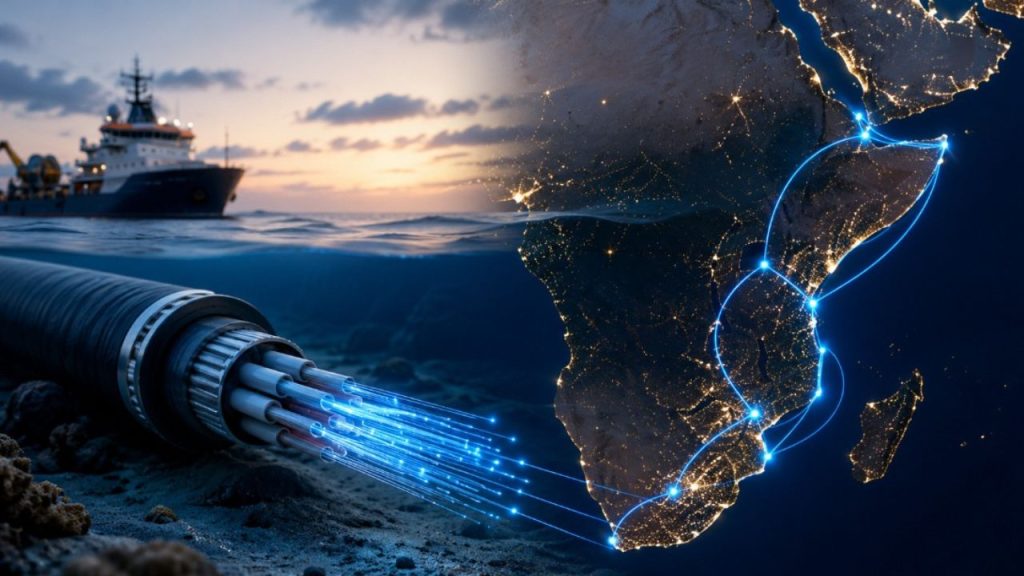
The system comprises two interconnected sections. The Blue cable runs across the Mediterranean, linking Italy, France and Greece to Israel, while the Raman section connects the Middle East to India through the Red Sea and Indian Ocean, with landing points in countries including Jordan, Saudi Arabia, Djibouti, Oman and India.
By Suleiman Mbatiah
Kenya is seeking to advance discussions on extending the Blue Raman Submarine Cable to the country as part of efforts to expand international digital connectivity and strengthen its position as a regional technology hub.
President William Ruto said the government would use the next Kenya-EU Digital Dialogue session, scheduled for November 23-24, to advance discussions on fiber-optic connectivity and explore the proposed extension of the submarine cable.
Speaking during a meeting with heads of European Union delegations to African countries at State House, Nairobi, on Thursday, Ruto said digital transformation presented significant opportunities for Kenya to expand its technology ecosystem and deepen cooperation with European research institutions.
Kenya has established a structured Digital Dialogue with the European Union, becoming the first African country to establish such a framework for cooperation in digital infrastructure, artificial intelligence, innovation and digital public services.
“Digital transformation offers another promising frontier. Kenya is the first African country to establish a structured Digital Dialogue with the EU, covering infrastructure, artificial intelligence, innovation, and digital public services,” Ruto said.
The proposed extension is part of the wider Blue Raman submarine cable project, an international telecommunications network designed to connect Europe and Asia through the Mediterranean, Middle East and East Africa.
Analysts are optimistic that the Google supported Blue-Raman cable will not suffer disruptions that its predecessors have succumbed to. Recently, there have been transmission failures by major digital cables that run along the EAC coastline causing widespread internet disruptions.
Most recently was the March 2025 damage to the PEACE cable which affected internet traffic across Africa and Asia. Before that, the EASSy and SEACOM systems also suffered connectivity failures across several East African countries.
The system comprises two interconnected sections. The Blue cable runs across the Mediterranean, linking Italy, France and Greece to Israel, while the Raman section connects the Middle East to India through the Red Sea and Indian Ocean, with landing points in countries including Jordan, Saudi Arabia, Djibouti, Oman and India.
The two sections are connected through terrestrial fiber infrastructure across Israel and the Middle East, providing an alternative route for international data traffic between Europe and Asia.
According to the European Investment Bank, the wider Blue-Raman system covers approximately 12,700 kilometers. Its project description identifies a Mediterranean section running from Palermo, Italy, to Tel Aviv, Israel, alongside terrestrial connections through Jordan and Saudi Arabia and an undersea section extending to Mumbai, India, with a branch to Djibouti.
The network is being developed through collaboration involving Google and Italian telecommunications company Sparkle, alongside regional partners including Omantel, Israel’s Bezeq and India’s Sify Technologies.
Each of the Blue and Raman systems is designed with 16 fiber-optic pairs. Industry publication Submarine Networks has reported a combined system capacity of 218 terabits per second.
The European Investment Bank has committed approximately KSh3.31 billion (£19.1 million) towards the project, whose estimated total cost is KSh28.78 billion (£166.1 million). Alcatel Submarine Networks was selected to supply and install the submarine cable, while Infinera was selected to provide the submarine line terminal equipment.
The wider initiative has also attracted support under the European Union’s Global Gateway strategy, which includes a KSh5.32 billion (£30.9 million) grant contribution towards the EU-Africa-India digital corridor.
The initiative is designed to provide high-speed, secure and diversified connectivity between Europe, India and Southeast Africa, with a dedicated network for research and educational institutions.
The European Commission identifies Kenya, Somalia, Tanzania, Djibouti, Ethiopia and India among the participating countries. The project will support connectivity for approximately 1,900 research and academic institutions in Southeast Africa and 1,850 institutions in India, alongside European institutions.
The initiative is being developed in collaboration with GÉANT, the pan-European research and education network, and the European Investment Bank.
Its capacity is also intended to accommodate potential future extensions into South Asia and Eastern Africa, creating opportunities for greater regional research collaboration and improved access to international digital infrastructure.
The deployment of the main Blue-Raman system has, however, encountered challenges. Industry reporting indicated that the western Mediterranean section and terrestrial connections across Israel had been completed by January 2026, while construction of the Raman section in the Red Sea faced delays associated with regional security concerns and increased maritime insurance costs.
The proposed East African expansion is expected to improve connectivity options for participating countries, potentially reducing the cost of international bandwidth and strengthening links between universities, research institutions and technology centers.
For Kenya, the discussions come as the government seeks to expand fiber-optic infrastructure and position the country as a regional center for digital innovation, artificial intelligence and technology-driven services.
Ruto said partnerships between European artificial intelligence research institutions and Kenya’s technology ecosystem could help the country develop its own digital solutions and intellectual property.
“Our ambition is to position Kenya not merely as a consumer of technology, but as a producer of innovation, solutions, and intellectual property,” he said.
During his June visit to Brussels, the President said the European Union had announced investments targeting the Northern Corridor, fiber-optic connectivity, digital land registration and digital transformation centers under the Global Gateway initiative.
He has urged the EU to mobilize additional affordable financing through concessional and blended financing instruments, with meaningful participation of African enterprises.
The proposed Blue Raman extension is part of broader efforts to deepen Kenya-EU relations as the two sides mark 50 years of diplomatic ties.
The partnership covers trade, investment, development cooperation, governance, climate action, digital transformation, peace and security, with Nairobi recently designated the EU’s fourth regional hub in Africa.
Ruto said the next phase of cooperation should prioritize investments and projects that deliver measurable economic and social benefits.
The European Commission President Ursula von der Leyen recently described the East African extension as a major step forward for regional digital development.
“Together with Italy, we will finance an extension of Blue-Raman from its African hub in Djibouti to Somalia, Kenya and Tanzania. This will connect East Africa to huge digital markets. It is a whole world of new opportunities, for Africa, for Europe and beyond,” she said.
About The Author