Kenya, Portugal Move To Boost Trade, Investment Ties
Mudavadi said Kenya is leveraging its regional connectivity and integration advantages to attract Portuguese investors, positioning Nairobi as a strategic base for accessing markets across East and Central Africa and beyond.
By Suleiman Mbatiah
Kenya is positioning itself as a gateway to a market of more than 1.3 billion people following new bilateral talks with Portugal aimed at boosting trade, investment, and access to Africa’s fast-growing economies.
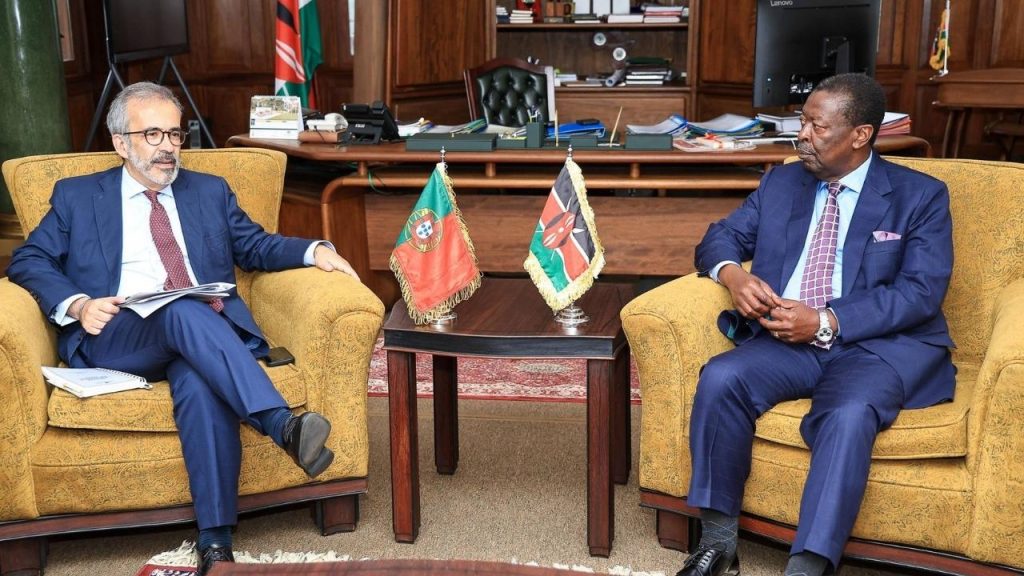
Kenya and Portugal agreed to strengthen economic cooperation during high-level talks in Nairobi, targeting increased trade volumes and deeper investment flows across sectors that both governments say remain significantly underexploited despite existing diplomatic and commercial ties.
Prime Cabinet Secretary and Foreign Affairs Cabinet Secretary Musalia Mudavadi said the discussions focused on reversing historically low trade volumes by enhancing collaboration between ministries, business councils, and investors through structured forums and coordinated trade missions.
“Notably, our trade volumes have historically been low; consequently, Kenya and Portugal recognize the imperative to maximise the immense potential that exists between our two economies,” Mudavadi said.
Mudavadi said Kenya is leveraging its regional connectivity and integration advantages to attract Portuguese investors, positioning Nairobi as a strategic base for accessing markets across East and Central Africa and beyond.
“Kenya is strategically positioned as the gateway to East and Central Africa. In this context, we invite Portuguese investors to choose Nairobi as their anchor for investment in the wider African market,” he said.
Officials highlighted that Kenya provides access to over 300 million consumers within the East African Community and a broader market exceeding 1.3 billion people under the African Continental Free Trade Area framework.
The two countries also committed to leveraging the Kenya European Union Economic Partnership Agreement to accelerate trade growth, reduce barriers, and support export expansion as part of broader efforts to strengthen bilateral economic relations.
Beyond trade, both governments identified the blue economy as a priority sector, with planned cooperation in sustainable fisheries, marine conservation, maritime transport, and ocean governance to support economic growth and environmental sustainability.
The partnership builds on previous collaboration at the 2022 United Nations Ocean Conference in Lisbon and is expected to advance further during the upcoming Our Ocean Conference scheduled to take place in Mombasa.
“We have to work towards protecting oceans from threats of pollution and climate change. This is part of the progress in advancing sustainable food security,” said Portugal’s Foreign Minister Paulo Rangel.
Rangel said Portugal is prioritising deeper engagement with African partners through investment and dialogue, linking ocean governance, climate action, and financing to broader geopolitical and economic cooperation with countries such as Kenya.
“The Ocean agenda and climate action and financing are a top priority for us. We want to deepen the dialogue and investment in Africa, building partnerships that will help us have a credible voice,” he said.
Both countries also signalled progress in labour mobility, citing the opening of a Portuguese visa processing centre in Nairobi as a step toward easing travel and supporting skills exchange between the two nations.
“Kenya and Portugal agreed to continue exploring mutually beneficial frameworks that facilitate skills mobility and protect the rights and welfare of our citizens abroad,” Mudavadi said.
At the multilateral level, Kenya and Portugal aligned on the need to reform global financial systems and institutions, including the United Nations Security Council, to better address climate change, debt risks, and regional instability.
Security cooperation remains central to the partnership, with both countries reaffirming support for diplomacy, peacekeeping, and joint efforts to address instability in regions such as the Horn of Africa and the Great Lakes.
“We have made progress that calls for action and follow up. We are calling on the private sector to come on board and support us,” Rangel said, urging sustained engagement beyond government commitments.
About The Author