New Findings Expose Scale Of Pesticide Contamination In Kenya
Researchers found pesticide residues distributed across entire ecosystems, with Murang’a County recording eleven different chemicals in bee products, indicating bioaccumulation, while studies in Kisumu detected contamination in all samples taken from five rivers.
By Suleiman Mbatiah
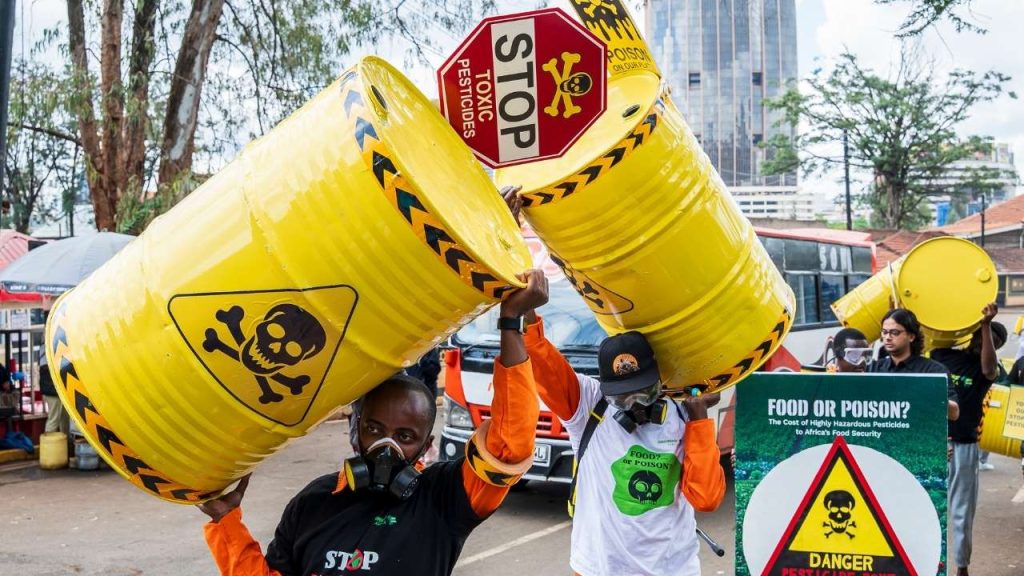
At least 67 pesticide active ingredients used in Kenya are classified as highly hazardous, with 67 percent toxic to soil organisms and 46 percent harmful to aquatic life, as a new report reveals widespread contamination in rivers and agricultural ecosystems amid weak monitoring systems.
The report, released by Greenpeace Africa, documents a growing environmental crisis across Kenya, linking pesticide exposure to declining soil health, polluted waterways, and collapsing pollinator populations critical to agricultural productivity and food systems.
Researchers found pesticide residues distributed across entire ecosystems, with Murang’a County recording eleven different chemicals in bee products, indicating bioaccumulation, while studies in Kisumu detected contamination in all samples taken from five rivers.
The chemicals identified include chlorpyrifos, glyphosate, imidacloprid, atrazine, diazinon, and acetamiprid, many classified as highly hazardous pesticides, with concentrations in water bodies reaching levels harmful to aquatic life and potentially unsafe for human exposure.
In Narok County, approximately 70 percent of water samples were contaminated with the fungicide carbendazim, rendering the water unsafe for infants and raising public health concerns in communities dependent on untreated water sources.
“We are poisoning the natural systems that our food depends on. The bees, the soil, and the rivers are the foundation of every farm in Kenya,” said Elizabeth Atieno, Food Campaigner at Greenpeace Africa, saying the findings reflect widespread ecological breakdown affecting the foundation of farming systems.
Of Kenya’s 141 registered pesticide active ingredients, 67 are classified as highly hazardous, representing nearly half, with 67 percent toxic to soil organisms, 46 percent to aquatic life, 41 percent to birds, and 18 percent to bees.
The report notes that despite Kenya’s recent ban on 77 highly hazardous pesticides, regulatory gaps remain, including continued use of chlorpyrifos for termite control and imidacloprid in greenhouse farming, limiting the overall impact of the restrictions.
“The data is unambiguous. These pesticides are not staying on farms,” Silke Bollmohr, the report’s author and researcher, highlighting that the contamination is spreading beyond farms into homes and ecosystems, while data gaps obscure the full scale of the crisis.
She added that residues are accumulating in household dust and waterways, exposing vulnerable populations, particularly children, while the lack of systematic monitoring across most African countries leaves policymakers operating without clear evidence.
Across Kenya and much of Africa, there are no coordinated national monitoring programmes tracking pesticide residues in soil, water, or food, leaving both environmental and human health impacts largely undocumented and poorly understood.
Agricultural stakeholders warn that smallholder farmers remain dependent on chemical inputs despite mounting risks, often lacking access to safer alternatives or adequate training on sustainable farming practices and soil management.
“Smallholder farmers are caught in a trap. They are sold the idea that chemicals are the only way to protect their crops,” Jeff Kahuho, Senior Programme Officer at PELUM Kenya, adding that farmers face structural constraints that limit change.
The report highlights agroecology as a viable alternative, citing evidence of improved soil health, restored biodiversity, and reduced chemical exposure, but notes that adoption remains slow due to limited investment and policy support.
It calls for a phased continental ban on highly hazardous pesticides, stricter enforcement of existing regulations, investment in farmer transition programmes, and the establishment of regional monitoring frameworks to track contamination and guide policy decisions.
About The Author