High Court: Gachagua’s Rights Were Violated, But Impeachment Stands
The judges dismissed allegations of bias and conflict of interest levelled against parliamentary leaders, lawmakers and senators, finding that the claims were based on political inference rather than objective evidence.
By Staff Writer
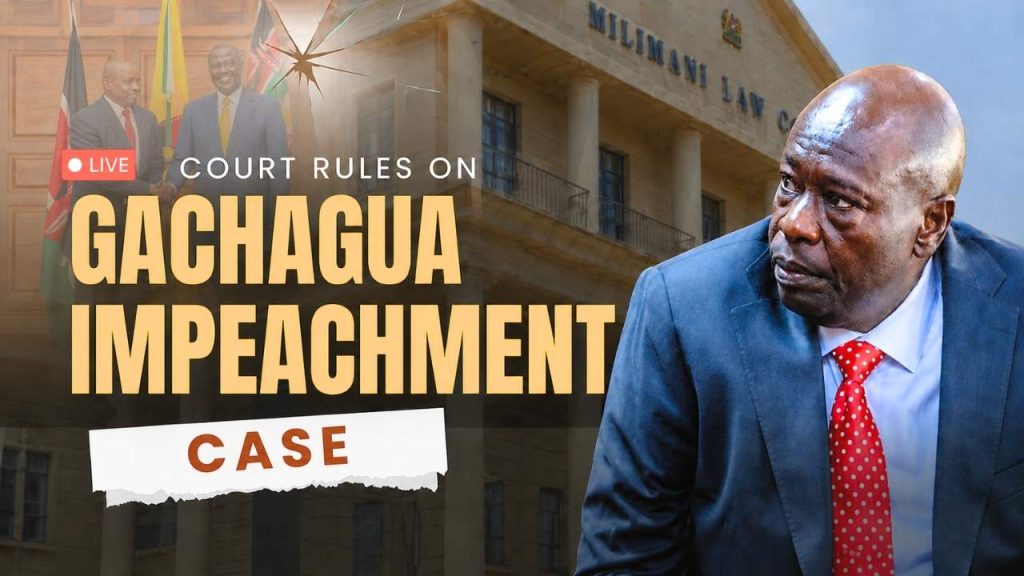
The High Court has this evening delivered a mixed verdict in petitions challenging the impeachment of former Deputy President Rigathi Gachagua, finding that his constitutional rights were violated during Senate proceedings but declining to nullify the impeachment or reinstate him to office.
In a judgment arising from multiple consolidated petitions, the three-judge bench held that Parliament largely complied with constitutional requirements during the impeachment process, effectively affirming Gachagua’s removal from office and the subsequent appointment of Deputy President Kithure Kindiki.
Justices Eric Ogola, Anthony Mrima and Freda Mugambi, however, found that Gachagua’s rights under Articles 47 and 50 of the Constitution were infringed when the Senate declined to grant an adjournment during the impeachment hearing.
The judges said the denial of an adjournment amounted to a violation of the former Deputy President’s right to fair administrative action and fair hearing. Nevertheless, they ruled that the infringement did not invalidate the impeachment process, citing the constitutional finality attached to Senate impeachment proceedings.
The ruling marks a significant legal setback for Gachagua, whose petitions had sought to overturn the Senate’s decision, challenge the validity of Kindiki’s appointment and secure various declarations relating to the impeachment process.
The bench found that the impeachment proceedings were justiciable and subject to judicial review, but concluded that both the National Assembly and the Senate acted within their constitutional mandate and largely adhered to the procedures governing the removal of a Deputy President.
The judges dismissed allegations of bias and conflict of interest levelled against parliamentary leaders, lawmakers and senators, finding that the claims were based on political inference rather than objective evidence.
The court also upheld the public participation process conducted by the National Assembly, ruling that it met the constitutional threshold. It further held that the Senate was not required to conduct a separate public participation exercise before considering the impeachment motion.
On the contentious issue of the vacancy created by Gachagua’s removal, the court affirmed that no involvement by the Independent Electoral and Boundaries Commission was required in the midterm replacement process under Article 149(1) of the Constitution.
The judges consequently upheld the nomination and appointment of Kindiki as Deputy President, finding that the process undertaken by the President, Parliament and the Senate complied with constitutional requirements.
In rejecting calls for Gachagua’s reinstatement, the court held that the Constitution does not contemplate the return of an impeached Deputy President after the office has already been filled.
The bench observed that reinstatement would create serious constitutional and practical difficulties, including the possibility of having two serving Deputy Presidents, a situation not envisaged by the Constitution.
While declining to reverse the impeachment, the court indicated that declaratory relief and damages could be appropriate remedies for the rights violations it identified during the Senate proceedings.
The judgment is expected to shape future constitutional debates on impeachment proceedings and may set the stage for a further legal battle, with Gachagua retaining the option of challenging the decision before the Court of Appeal.
The judges also urged Parliament to enact a dedicated legal framework governing the removal of a Deputy President, saying the existing constitutional provisions leave important procedural questions unresolved.
The ruling brings to a close one of the most consequential constitutional disputes since the 2022 General Election, while leaving open questions about the extent to which courts can intervene in impeachment processes after Parliament has exercised its constitutional authority.
About The Author