Ruto Courts Norwegian Investment To Transform Agriculture, Expand Export Markets
The initiative aims to reduce Kenya’s dependence on imported fertiliser, lower production costs for farmers and improve food security at a time when rising global prices continue to affect agricultural productivity.
By Suleiman Mbatiah
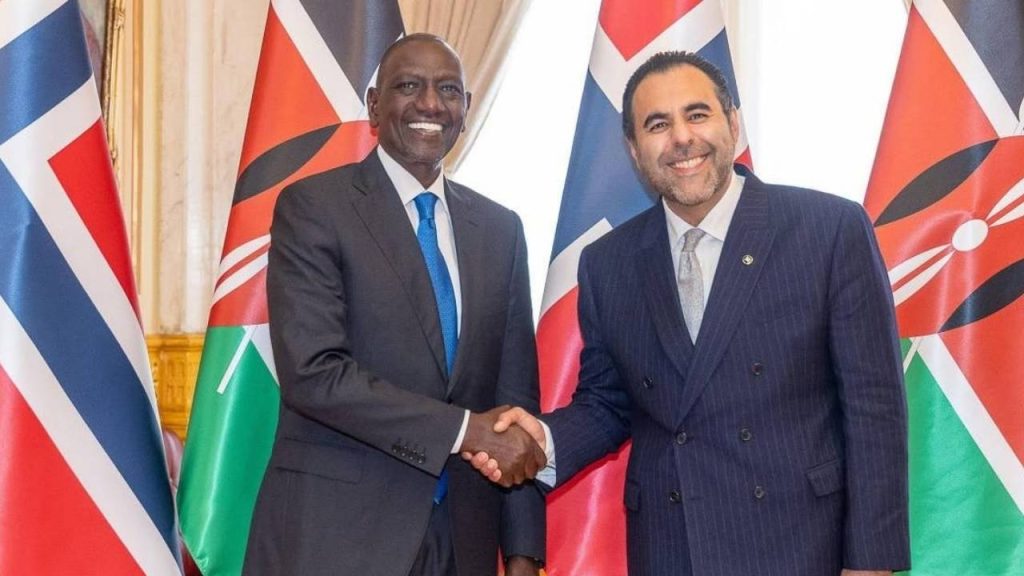
Millions of farmers could benefit from cheaper fertiliser and stronger export links under new proposals unveiled by President William Ruto, who urged Norwegian firms to invest in agriculture and help transform Kenya into a regional food production hub.
Speaking at the Norway-Kenya Business Forum in Oslo on Tuesday, President Ruto outlined plans to deepen economic ties between the two countries through investments in agriculture, renewable energy, fisheries and digital innovation.
The President said Kenya was repositioning itself as a gateway to African and European markets, leveraging its renewable energy resources, expanding trade agreements and growing investor confidence to attract long-term capital.
“We are natural partners,” President Ruto said as he highlighted decades of cooperation between Kenya and Norway and pointed to shared interests in climate-smart agriculture, clean energy and sustainable economic development.
A key proposal focused on agriculture, where the President called for a Kenya-Norway Green Ammonia Initiative involving Norwegian companies to produce low-carbon fertiliser using Kenya’s geothermal energy resources.
The initiative aims to reduce Kenya’s dependence on imported fertiliser, lower production costs for farmers and improve food security at a time when rising global prices continue to affect agricultural productivity.
Agriculture remains central to Kenya’s economy, contributing about a fifth of gross domestic product directly and supporting millions of livelihoods through farming, processing, transport and trade, according to government and World Bank data.
Ruto also proposed stronger partnerships between Norwegian retailers and Kenyan producers to create direct supply chains linking farmers to overseas consumers, improving traceability and potentially increasing returns for agricultural exports.
“In agriculture, I propose a Kenya–Norway Green Ammonia Initiative; with Yara International and N2 Applied; to produce low-carbon fertiliser from Kenya’s geothermal energy, improving food security and reducing imports,” he said.
The President argued that Kenya offered investors access to a market far larger than its population of about 55 million through regional and continental trade arrangements already in force.
He cited the African Continental Free Trade Area, which connects businesses to a market of roughly 1.4 billion people, alongside regional blocs including the East African Community and COMESA.
Kenyan manufacturers also enjoy duty-free and quota-free access to European Union markets under the EU-Kenya Economic Partnership Agreement, an advantage the government hopes will attract export-oriented industries.
Ruto said Kenya’s clean energy credentials strengthened its investment case, noting that more than 90 per cent of the country’s electricity is generated from renewable sources, including geothermal, wind and hydro power.
The President further pointed to recent economic indicators, including foreign direct investment inflows that surpassed $3 billion in 2025 and reforms aimed at simplifying business licensing and regulatory approvals.
“The opportunity is real. The foundations are in place. The partnership is proven. The moment is now,” President Ruto told business leaders as he appealed for greater Norwegian participation in Kenya’s economic transformation.
He said stronger investment partnerships would help convert Kenya’s renewable energy advantages, agricultural potential and strategic location into jobs, exports and industrial growth benefiting both countries over the coming years.
About The Author