Kenya, India Move To Seal Free Trade Deal
India is currently one of Kenya’s largest global trading partners. Mudavadi noted that Kenya has also entered into a Preferential Trade Agreement with China under the Forum on China-Africa Cooperation (FOCAC) arrangement, underscoring a broader strategy of diversifying and deepening trade ties across key economies.
By Jane Chepkurui
Kenya and India are closing in on a landmark free trade agreement that could significantly deepen economic ties between the two nations, with Nairobi eyeing expanded market access and a rebalancing of one of its most consequential trading relationships.
Prime Cabinet Secretary Musalia Mudavadi confirmed that formal negotiations are underway following high-level engagements in New Delhi in early 2026, where he held bilateral talks with Prime Minister Narendra Modi and Foreign Minister S. Jaishankar on the sidelines of the Raisina Dialogue — a premier global forum that convenes the world’s leading think tanks and policymakers.
Mudavadi, who also serves as Cabinet Secretary for Foreign and Diaspora Affairs, said Kenya has been deliberately broadening its trade architecture in recent years. Beyond India, Nairobi has already concluded trade agreements with the European Union and the United Arab Emirates, and is currently in active discussions with the United States. Kenya has also secured a Preferential Trade Agreement with China under the FOCAC framework — a continental arrangement covering African nations.
“One of the things we are pursuing is to take the partnership a notch higher and discuss a free trade agreement between Kenya and India. Kenya now has a trade agreement with the European Union, the United Arab Emirates, and we are now having talks with the United States,” said Mudavadi.
India ranks among Kenya’s largest trading partners globally, making the proposed agreement a strategically significant one. Mudavadi said the deal, once concluded, would extend well beyond tariffs and trade volumes, creating a broader platform for investment, technology exchange, and people-to-people cooperation that would benefit citizens on both sides.
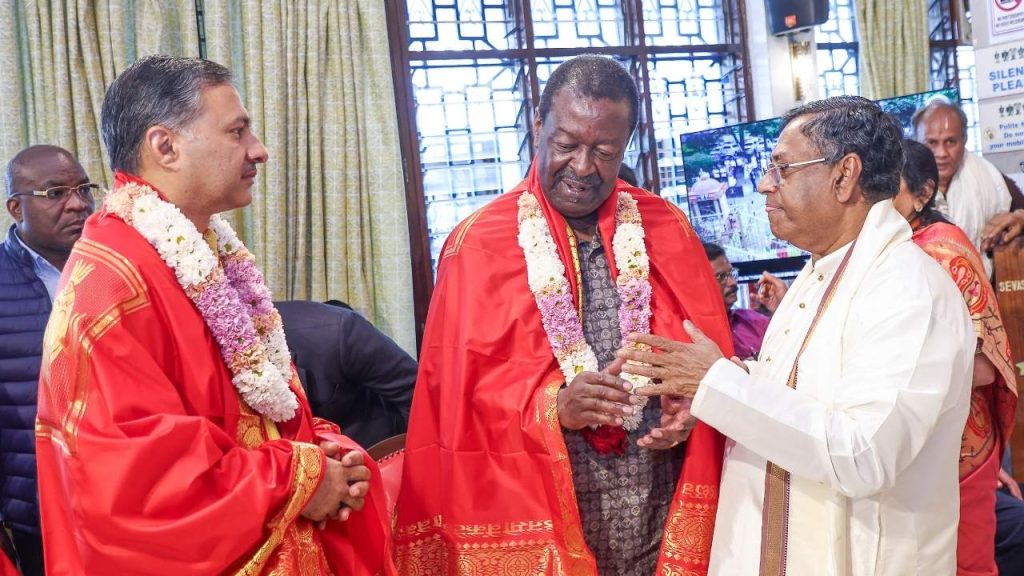
The Prime CS was speaking on Sunday at the 2nd Kumbhabhisheka Mahotsavam ceremony at the Sri Kalyana Venkateswar Temple in Nairobi — a sacred Hindu consecration ritual observed every 12 years to renew, re-energize, and sanctify a temple’s deities and structure. The occasion brought together members of Kenya’s Indian community, religious leaders, and dignitaries.
Addressing the gathering, Mudavadi paid tribute to the outsized role the Indian community has played in Kenya’s economic development, citing contributions spanning decades and cutting across multiple sectors. He pointed to job creation, capital investment, technology transfer, and education as areas where the community’s impact has been particularly pronounced.
“Your contribution and support to Kenya’s economy as the Indian community has helped shape our wellbeing through job creation, investment, technology transfer, and education, among other areas of critical support,” he said.
The Prime CS noted that Kenya’s rise to become the sixth largest economy in Africa, according to IMF rankings, is in part a reflection of the collaborative effort between the government and communities like the Indian diaspora, who have been active participants in the country’s growth story over generations.
Mudavadi also reaffirmed the Kenyan government’s commitment to religious tolerance and cultural respect, underscoring that the country’s Constitution guarantees freedom of worship and provides a firm legal foundation for all communities to practice their faith and preserve their heritage without fear.
“The government of Kenya respects your culture and tradition, and our Constitution provides that anchoring so that everybody feels at home. When you respect culture, you are respecting a civilization, you are respecting a people and humanity,” said Mudavadi.
The Sri Kalyana Venkateswar Temple has over the years awarded scholarships and education sponsorships to more than 300 children across various schools in Kenya. For the past 24 years, the temple has also been a consistent presence in food distribution and drought relief efforts, cementing its role not just as a place of worship but as a pillar of community support.
About The Author