Boost for Religious Tourism as Nakuru Temple Unveils East Africa’s Tallest Hanuman Statue
In Kenya, key religious tourism sites include the Subukia National Marian Shrine and Heaven’s Gate Prayer Centre in Nakuru, the Kaya forests in Kilifi, the Lord Shiva Temple in Mombasa, Kongo Mosque in Kwale, and Rabai Church in Kilifi among others.
By Suleiman Mbatiah
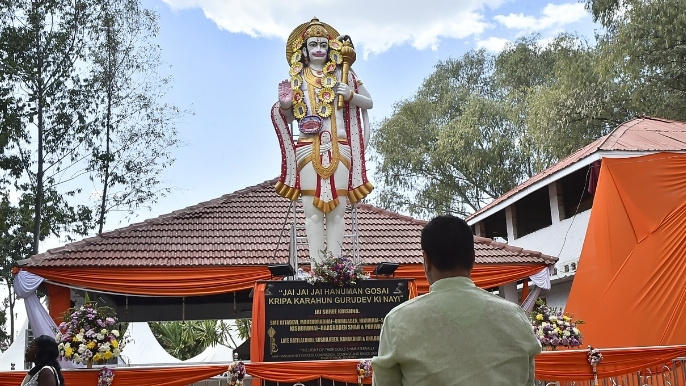
Nakuru County has added a major religious landmark to its skyline with the unveiling of a 20-foot statue of Lord Hanuman at the 110-year-old Shri Krishna Temple in Section 58, Nakuru Town East.
Temple leaders and government officials say the new landmark could boost Nakuru’s profile as a religious tourism hub, drawing more pilgrims, visitors, and investment into the city.
The global religious tourism market was valued at about KSh 36.9 trillion (USD 286.6 billion) in 2024 and could hit KSh 86.7 trillion (USD 671.9 billion) by 2030, driven by cultural and spiritual travel interest.
The stone statue, carved by local artisans in Nakuru using material sourced from quarries in Kisii County, is believed to be the tallest Lord Hanuman statue in East Africa and the second tallest in Africa after a similar monument in Chatsworth, Durban, South Africa.
Temple chairman Shailesh Sheth said the project took 10 months to complete and involved extensive logistical and technical work, including transporting the massive stone and erecting the statue within the temple grounds.
“It took time, but the finished murthi is comparable to what one would bring from India,” Sheth said, noting that the scale, detail, and craftsmanship reflect both deep religious devotion and the skill of the local artisans.
The unveiling drew hundreds of devotees and visitors to Nakuru and followed three days of religious and cultural activities, culminating in a procession through major city roads marked by chanting and dance.
Sheth said the temple expects the statue to attract increased pilgrimage from across Kenya and the region, adding to Nakuru’s growing profile as a hub for faith-based tourism.
He said the temple has begun installing benches, shaded resting areas, and a water fountain to accommodate visitors, with plans to support annual religious Krishna processions in the city.
The project was fully funded by the Nikubhai Shah family, with support from the families of Shailesh Sheth and Ilyas Patel. Speaking on behalf of the family, Niku Shah said the statue was offered in memory of their late father, Ratilal Shah.
More than 2,000 devotees, including Kenyans of African heritage who have embraced the Krishna movement, travelled from Nairobi, Kisumu, Eldoret, Nanyuki, and Mombasa to attend the ceremony, highlighting the event’s growing religious tourism appeal.
India’s Deputy High Commissioner to Kenya, Sushil Prasad, who was the chief guest, said the unveiling reflected the long-standing presence of the Indian community in Kenya and its contribution to the country’s social and economic life.
He also announced plans by the Indian High Commission to hold a consular camp in Nakuru in March to provide passport, visa, and related services to Indian nationals in the region.
Leaders of the Hindu community said the statue is expected to place Nakuru more firmly on regional pilgrimage and cultural tourism circuits, alongside the city’s established role as a transport and commercial centre.
National Hindu Council of Kenya chairperson, Sujata Kotamraju said the installation marked a proud moment, noting that temples in Naivasha, Nakuru, Machakos, and Kitengela now offer comprehensive religious services, reducing the need for devotees to travel abroad.
“Our temples now provide what many devotees seek spiritually, right here in Kenya,” she said, noting that the growing network of temples has strengthened religious life locally and allowed worshippers to observe rituals, festivals, and traditions with ease.
Nakuru Minister for Tourism Stephen Kuria said the development comes as the county government embarks on an ambitious infrastructure development to match the demand for religious tourism by improving accessibility, comfort, and safety for visitors to pilgrimage destinations and complementing sites.
He explained that the pilgrims visiting Nakuru will also be able to sample nearby attractions, including Lake Nakuru National Park and the Menengai Crater, both located within the city and only minutes from the temple.
The Minister said the county will partner with the temple and other tourism stakeholders to amplify Nakuru’s profile as a growing hub for Meetings, Incentives, Conferences and Exhibitions, commonly known as MICE tourism, and enhancing the overall travel experience.
“This also introduces Indian cuisine into our local food offering, driven by the growing number of visitors from South Asia, a region widely known for its rich culinary traditions,” he said, while acknowledging the capacity of local hotels.
Top religious tourism cities include Mecca and Medina in Saudi Arabia, Vatican City, Jerusalem, Mashhad, Varanasi, Amritsar, Lourdes, Fátima, Santiago de Compostela, and Bodh Gaya, drawing millions of pilgrims across Islam, Christianity, Judaism, Hinduism, Sikhism, and Buddhism.
In Kenya, key religious tourism sites include the Subukia National Marian Shrine and Heaven’s Gate Prayer Centre in Nakuru, the Kaya forests in Kilifi, the Lord Shiva Temple in Mombasa, Kongo Mosque in Kwale, and Rabai Church in Kilifi among others.
About The Author