Ruto Sets Fresh Devolution Agenda, Targets County Funding, Pending Bills
The President also directed that Intergovernmental Sector Forums be fully operationalized so that technical disagreements can be addressed before they escalate into formal disputes.
By Suleiman Mbatiah
President William Ruto has unveiled a fresh agenda to strengthen devolution, putting county financing, pending bills, performance monitoring, intergovernmental disputes and ownership of public assets at the center of efforts to improve service delivery.
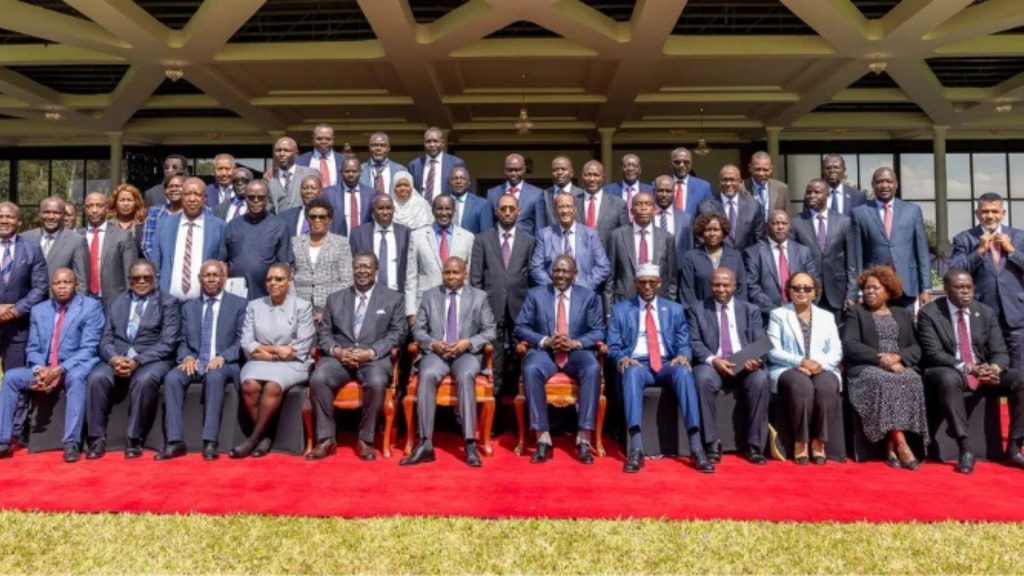
Speaking during the 13th National and County Governments Coordinating Summit at State House, Nairobi, today, Ruto said the success of devolution depended on closer cooperation between the two levels of government and better use of public resources.
He said the Government had made progress in clarifying the responsibilities of national and county governments, but warned that the transfer of functions must be matched with adequate resources.
“Devolution cannot succeed when functions move but resources remain behind; when responsibilities are assigned without capacity; or when expectations are created without the means to meet them,” Ruto said.
The President said recommendations had been developed following verification of an interim allocation of KSh65.9 billion, with the proposals expected to be submitted to the National Treasury for consideration in the 2027/28 financial year.
The move could pave the way for the transfer of additional resources to counties to support functions that have already been devolved.
Ruto said the Government had also completed the delineation, unbundling and gazettement of several devolved functions that had previously been contested.
These include electricity and gas reticulation and energy regulation, sporting activities and facilities, fisheries, and soil and water conservation.
He said clearer assignment of responsibilities would help eliminate duplication and make it easier to hold public institutions accountable for their performance.
“This clarity will reduce duplication, strengthen accountability, and improve service delivery,” the President said.
The President also placed the growing burden of pending bills at the center of the Government’s devolution agenda, warning that unpaid government debts were hurting businesses and threatening jobs.
“As the next election cycle approaches, pending bills remain a major concern across both levels of Government. They undermine businesses, destroy jobs, and weaken confidence in Government,” he said.
Ruto said the impact was particularly severe on small and medium-sized enterprises that depend on government contracts and payments to maintain their operations.
“For many enterprises, especially small and medium-sized businesses, an unpaid Government bill is not merely an accounting entry. It is working capital withheld, salaries delayed and livelihoods placed at risk,” he said.
He called on the Office of the Controller of Budget and the Office of the Auditor-General to work with counties to verify pending bills, develop credible payment plans and facilitate their settlement.
The President said counties had been allocated KSh503.5 billion for the 2026/27 financial year, comprising KSh428 billion in equitable share and KSh75.5 billion in conditional allocations.
The equitable share increased from KSh415 billion in the previous financial year to KSh428 billion.
However, Ruto said increasing allocations alone would not be enough to demonstrate the success of devolution, arguing that public resources must translate into visible improvements in people’s lives.
“Strengthening devolution is not simply about transferring more money. It is about converting every shilling into a service, every allocation into an opportunity and every public investment into a measurable improvement in the lives of citizens,” he said.
He said Kenyans judged devolution through the services they received rather than through government structures or budget figures.
“Kenyans do not experience devolution through budget figures or institutional structures. They experience it through medicine in hospitals, water in their homes, accessible roads, productive farms, cleaner towns, and responsive public services,” Ruto said.
The President also directed the National Treasury to work with the Intergovernmental Relations Technical Committee (IGRTC) to provide resources for the evaluation of the performance of both levels of government.
The evaluation framework has already been developed through a multi-agency process, but sectoral assessment has been delayed by budgetary constraints.
Ruto said measuring government performance was essential if weaknesses were to be identified and corrected.
“What is not measured cannot be improved; what is not evaluated cannot be strengthened; and what is not accounted for cannot inspire public confidence,” he said.
The directive comes as the Government seeks to place greater emphasis on measurable results from public spending and implementation of devolved functions.
Ruto also urged national and county governments to rely more heavily on alternative dispute resolution when disagreements arise.
He said disputes over roads, water, infrastructure, land and health were increasingly being resolved through alternative mechanisms, reducing reliance on lengthy court battles.
“Disagreement between institutions is sometimes inevitable. Dysfunction is not. Our responsibility is to resolve disputes early, lawfully, and constructively, without allowing institutional differences to become obstacles to service delivery,” he said.
He called for closer cooperation between IGRTC and the Judiciary to facilitate the referral of suitable intergovernmental disputes to alternative dispute resolution.
The President also directed that Intergovernmental Sector Forums be fully operationalized so that technical disagreements can be addressed before they escalate into formal disputes.
“Consultation must come before confrontation, coordination before litigation and resolution before disruption,” he said.
Another priority outlined by the President is the transfer and registration of legal ownership of assets gazetted for counties.
He directed county governments to initiate and fast-track the necessary legal processes through the National Land Commission and the State Department for Lands.
The move is intended to resolve outstanding questions over ownership of assets associated with devolved functions.
Ruto said the Government’s wider objective was to create a devolved system in which responsibilities, resources and accountability are properly aligned.
The President said the five priorities agreed upon at the summit — operationalizing intergovernmental sector forums, strengthening alternative dispute resolution, settling pending bills, evaluating government performance and transferring legal ownership of county assets — should be treated as interconnected reforms.
“Together, they are about making devolution work better through clarification of responsibilities, matching functions with resources, resolving disagreements efficiently, strengthening accountability and ensuring that public institutions deliver for the citizen,” he said.
He urged national and county governments to maintain cooperation despite their separate constitutional mandates.
“Neither level of Government can succeed by acting in isolation. Our mandates may be distinct, but the citizen we serve is the same; our responsibility is shared; and our objective is one: to improve the lives of the people of Kenya,” Ruto said.
The President said the ultimate measure of devolution should be its impact on citizens rather than institutional arrangements.
“Let this Summit therefore renew our shared determination to make devolution work; not in theory, but in practice; not for institutions, but for citizens; and not for political convenience, but for Kenya’s transformation,” he said.
About The Author