Ruto Says Politicians Should Not Control Vision 2030 Successor
He said the charter should come from an open, inclusive, and honest national conversation involving farmers, workers, entrepreneurs, scholars, faith leaders, professionals, innovators, young people, and other citizens.
By Staff Writer
President William Ruto has called for a national development consensus that can outlast governments and election cycles, saying future political competition should be about who can best deliver an agreed national vision.
He said work on Vision 2030’s successor would begin on August 12 and should not be controlled by politicians, government officials, or a small group of experts.
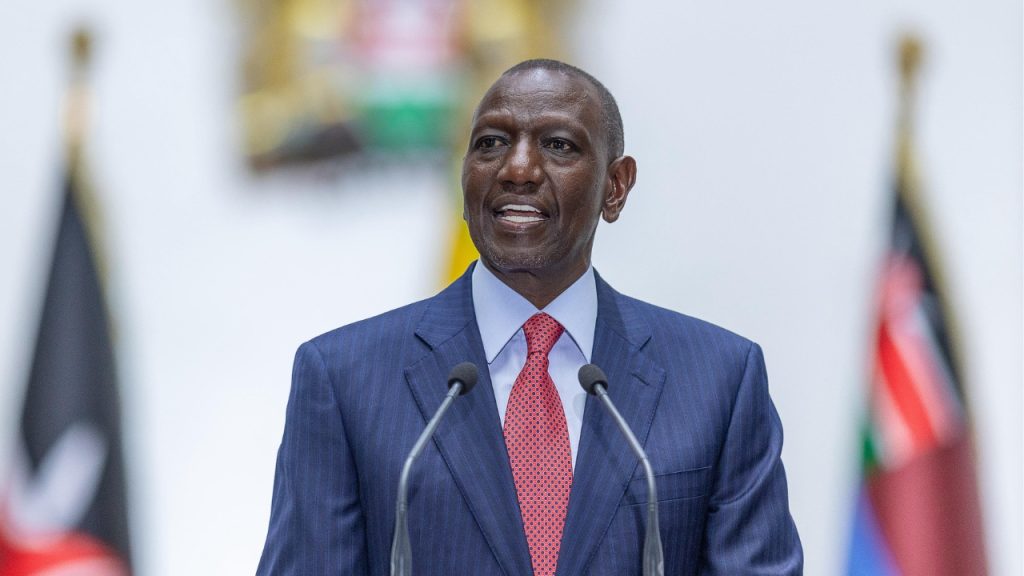
In a special address from State House this evening, Ruto described the planned National Conversation on Kenya’s Future Beyond Vision 2030 as the country’s biggest public participation exercise since 2010.
He said the forum would involve every county and state institution, political parties, businesses, workers, faith communities, universities, professionals, innovators, civil society, the creative industry, and young people.
“A national development charter for the attainment of these noble constitutional imperatives cannot be designed by politicians alone, nor by any single institution, profession, or interest group,” Ruto said.
He said the charter should come from an open, inclusive, and honest national conversation involving farmers, workers, entrepreneurs, scholars, faith leaders, professionals, innovators, young people, and other citizens.
Ruto described public participation as a constitutional duty and said the resulting vision should turn national ideals into measurable outcomes on development, better lives, shared prosperity, and long-term change.
He tied that to Article 43, which guarantees health, housing, sanitation, food, water, social security, and education, and asked what practical standards should show those rights are being realised.
The President said Vision 2030 had guided public policy, driven investment, and shaped national planning for nearly two decades, but that with its end approaching, the country needed an honest assessment of what remains unfinished.
“Vision 2030 set a target of Kenya becoming an upper-middle income country by 2030. So far, we are off target,” Ruto said, while urging reflection rather than disappointment.
He said the shortfall was not an indictment of Vision 2030 or a reason for despair, but a chance to learn from what worked, confront weaknesses, and agree on Kenya’s next direction.
The address gave four reasons to act now: restored economic stability, the approaching end of Vision 2030, an emerging African growth wave, and the Constitution’s still-unmet promise of development and shared prosperity.
Ruto said his administration had stabilized the currency, lowered inflation and borrowing costs, restored investor confidence, and rebuilt foreign-exchange reserves to more than KSh1.94 trillion, which he said was equal to six-and-a-half months of imports.
Central Bank data, however, put reserves at KSh1.79 trillion, covering 5.9 months of imports as of July 23, below the figure cited in the speech, based on Thursday’s official exchange rate of KSh129.40 to the dollar.
“Because we have restored stability, rebuilt investor confidence, and laid a firm foundation for our economy, now is the perfect opportunity for Kenya to begin shaping the next phase of our national development,” Ruto said.
He said foreign direct investment last year hit a record KSh414.08 billion, more than double the 2022 figure, and cited an IMD ranking that placed Kenya first among Africa’s six assessed economies.
Ruto said the National Infrastructure Fund would finance major projects sustainably, while the Sovereign Wealth Fund would preserve and invest national wealth, distribute prosperity fairly, and protect opportunities for future generations.
He said those institutions reflected a nation-building approach based on durable structures that encourage investment, protect intergenerational wealth, solve problems, and give people room to work, innovate, and create wealth.
Looking abroad, Ruto traced waves of industrialization through South Korea, Singapore, Taiwan, Hong Kong, China, Malaysia, Thailand, Indonesia, Mauritius, Vietnam, India, Bangladesh, and Cape Verde, saying Kenya missed each one.
“The third reason why this is our moment is that the next great wave of economic transformation will, I believe, be African,” Ruto said. He argued that Kenya should take advantage of that opportunity.
Ruto said Kenya and South Korea each produced about KSh14,200 per person in 1965. Today, he said, Kenya is near KSh310,600, while South Korea stands at KSh4.66 million.
He added that China rose from KSh25,900 per person, when Kenya was near KSh58,200, to more than KSh1.81 million. Vietnam, once at half Kenya’s level, reached KSh647,000; Ghana KSh414,100; and Zimbabwe KSh388,200.
He said Africa’s youth, strategic minerals, renewable energy, arable land, and consumer markets were strengths, and noted that nine of the world’s fastest-growing economies are in Africa and that one in four people will be African by 2050.
Ruto said the Constitution envisions a democratic, wealthy, and prosperous nation, and that its Preamble, Article 10, and Article 3 require dignity, equality, social justice, integrity, accountability, patriotism, and sustainable development.
“The future of Kenya is too important to be left to politicians alone. It must be imagined, shaped and built by each one and all of us,” Ruto said.
Once consensus is reached, he said, democracy should then be about the ideas, policies, and ability needed to get there faster, more efficiently, and more inclusively, rather than repeatedly redefining the destination.
He said months of consultations with leaders, scholars, businesses, faith groups, professionals, civil society, grassroots representatives, and young Kenyans had convinced him that government could not write the vision on its own or shut out global ideas.
He said he had asked professors Hiroyuki Hino, Anyang’ Nyong’o, Michael Chege, Karuti Kanyinga, and Peter Wanyande to examine Kenya’s post-2030 future, and that they submitted proposals last week as a starting point for public debate.
Their main proposal, he said, was that Kenya could become prosperous, high-income, industrialized, and globally competitive within one generation if citizens united behind disciplined execution and recognised that today’s choices will shape what they leave their children.
“In 2010, we gave ourselves a Constitution worthy of our dreams. The task of our generation is to build a nation worthy of that Constitution,” Ruto said.
About The Author