Kihika Expands Education Funding With Kshs 447 Million Bursary Allocation
Beyond bursaries, the county reported expanded investment in early childhood education, including construction of classrooms, hiring teachers, and provision of learning materials, alongside increased vocational training capacity and infrastructure development.
By Suleiman Mbatiah
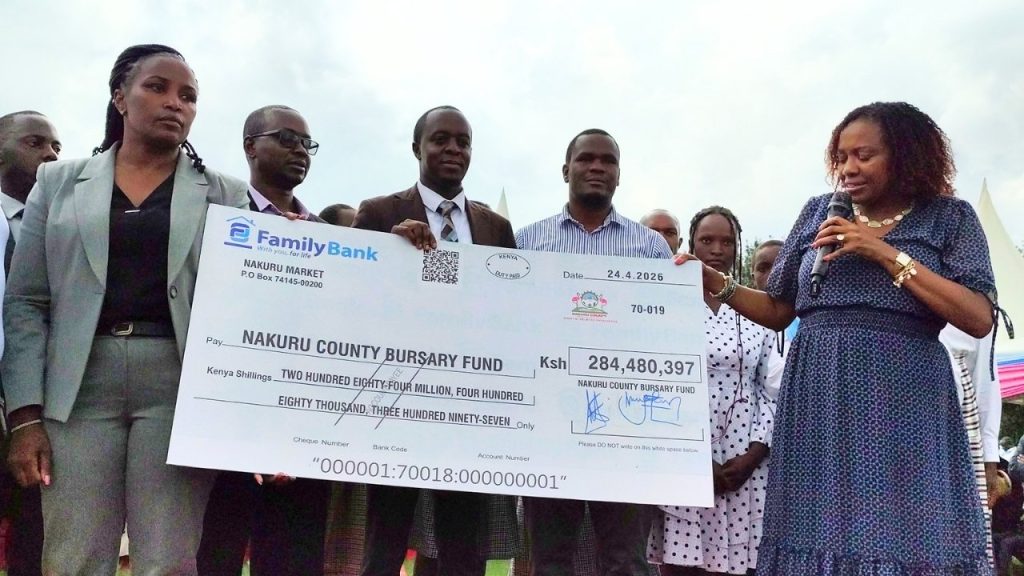
The County Government of Nakuru has increased its bursary allocation to Kshs 447 million for the 2025/2026 financial year, with Kshs 284.4 million already released to more than 57,000 learners in a major push to expand access to education and reduce dropout rates.
The first tranche, amounting to Kshs 284,480,397, has been disbursed to 57,231 beneficiaries across universities, colleges, secondary schools, vocational training centres, and special schools, marking one of the largest education support rollouts in the county’s recent history.
Secondary school students account for the largest share of beneficiaries, with 42,724 learners receiving Kshs 163.45 million. College students follow at 5,655 beneficiaries allocated Kshs 44.96 million, while 4,719 university students received Kshs 33.69 million. Vocational trainees number 3,477, with special schools supporting 656 learners through targeted funding.
Governor Susan Kihika said the programme is designed to improve access, retention, completion, and transition rates across all levels of education while addressing financial barriers that continue to lock out vulnerable learners.
“Today’s event goes beyond a ceremonial launch. It represents hope, opportunity, and a shared belief that every child, regardless of their background, deserves a chance to learn, grow, and succeed,” she said during the launch at Kiamaina Primary School in Bahati Sub-County.
Sub-county allocations show Naivasha received the highest funding at Kshs 43.14 million for 8,300 learners, followed by Nakuru Town West at Kshs 36.58 million and Njoro at Kshs 31.52 million. Other allocations include Rongai with Kshs 25.74 million, Bahati at Kshs 25.60 million, and Gilgil at Kshs 23.86 million, reflecting an effort to distribute resources equitably across the county.
Additional allocations were made to Kuresoi South, which received Kshs 19.45 million, Kuresoi North at Kshs 18.74 million, Molo at Kshs 19.97 million, Subukia at Kshs 12.65 million, and Nakuru Town East at Kshs 27.19 million.
In Bahati Sub-County alone, 5,885 students benefited from Kshs 25.6 million. Ward-level distribution shows Kiamaina receiving the highest allocation at Kshs 5.82 million for 1,474 students, followed by Lanet Umoja with Kshs 5.90 million, Bahati ward at Kshs 4.29 million, Kabatini at Kshs 4.79 million, and Dundori at Kshs 4.78 million.
The county has also awarded 69 full scholarships targeting vulnerable learners, with Naivasha receiving 13 scholarships, Bahati 12, Rongai 10, Subukia 8, Njoro 6, Nakuru Town West 5, Nakuru Town East 4, Gilgil 4, Kuresoi North 4, and Kuresoi South 3.
The bursary allocation has steadily increased from Kshs 177.8 million in the governor’s first year in office to Kshs 440 million last year, before rising to the current Kshs 447 million, signalling a sustained policy shift towards education investment as a development priority.
Beyond bursaries, the county reported expanded investments in early childhood education, including 1,073 public ECDE centres, construction of 230 classrooms and 82 toilets, and equipping 311 classrooms alongside 12 kitchens. Daily feeding programmes have pushed enrolment from 58,000 to 66,000 learners.
The county has also employed 192 ECDE teachers on permanent terms and confirmed 306 others, while continuing to train over 3,000 teachers annually on the competency-based curriculum. Instructional materials worth Kshs 17 million have also been distributed to support learning.
In vocational training, Nakuru has disbursed more than Kshs 480 million in capitation grants, supplied equipment worth Kshs 67 million to over 30 centres, and expanded facilities with investments exceeding Kshs 120 million. The number of operational centres has grown from 33 to 43, with enrolment rising from 2,000 to 6,850 trainees.
More than 4,000 students graduated from vocational institutions in 2024, with over 3,000 expected to complete training in November 2026. The county has also recruited 57 instructors and initiated the hiring of 66 more, while integrating digital learning and aligning training programmes with market demands through international partnerships.
Governor Kihika said the combined investments in bursaries, ECDE, and vocational training are aimed at building a skilled and self-reliant generation capable of driving the county’s economic growth.
“Education remains the most powerful tool we can use to transform lives and shape the future of our county,” she said, urging continued collaboration among stakeholders to sustain access to learning.
About The Author