GOONISM: Political Violence Suspects Should Face Criminal Law, Lunalo Says
By Suleiman Mbatiah
A Nakuru human rights advocate has called for people involved in violence during political activities to be investigated and prosecuted for specific criminal offences, rather than being broadly described as “goons.”
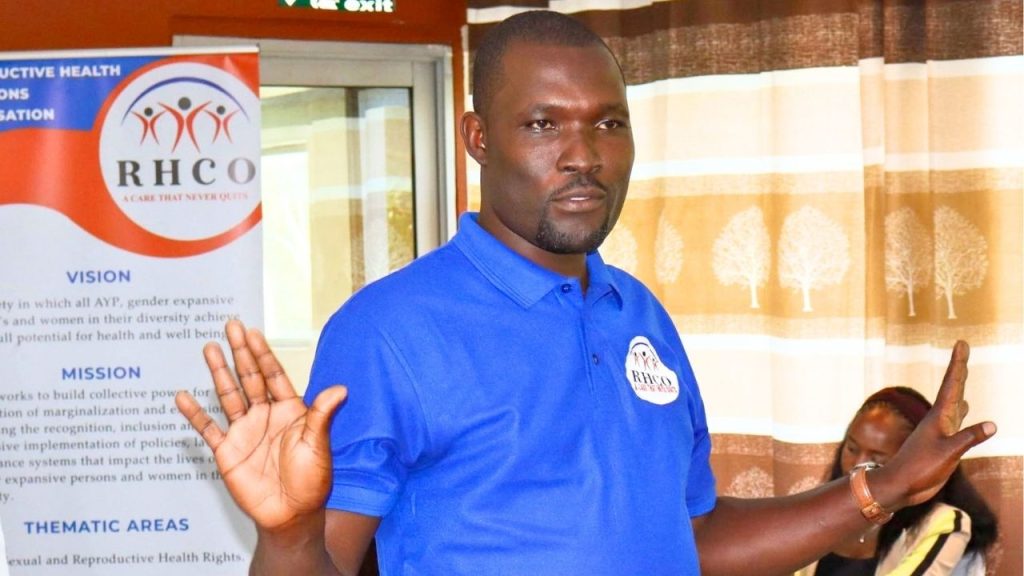
Martin Lunalo, executive director of Reproductive Health and Champions Organization (RHCO), said labels often used in political debate can blur responsibility for offences such as assault, sexual violence and election-related intimidation.
He also urged political leaders and security agencies to protect women from violence during campaigns, saying political affiliation can never justify rape, physical attacks or killings.
“We cannot justify violence. We cannot profile violence and say that because it is that political camp that is doing politics, it’s okay for women to be butchered, to be raped. It’s okay for people to be beaten around,” Lunalo said.
Lunalo spoke at a forum with journalists in Nakuru on implementation of the 2010 Constitution. The meeting looked at how to make the Constitution’s preamble more accessible to citizens and focused on diversity, coexistence and the promise that every Kenyan should be able to take part in public life and access state services without exclusion.
He based his argument on Article 27 of the Constitution, which guarantees equality before the law, equal protection and freedom from discrimination. He said those guarantees should apply regardless of a person’s beliefs, values or political affiliation.
Kenyan law already sets out offences under which political violence can be investigated. Section 11 of the Election Offences Act covers the use of force or violence during an election period, while assault, homicide, sexual offences, arson and malicious damage are covered under criminal law.
His comments came amid concern over violence during a Linda Mwananchi rally in Homa Bay on August 16 that left two people dead, including a police officer, and 46 injured. Police said they arrested 37 suspected gang members and recovered machetes, ropes, metal rods, knives, rungus, batons and torches.
The Kenya National Commission on Human Rights said it documented a series of violent political incidents between June and August, including the disruption of a budget forum at All Saints Cathedral in Nairobi on June 12, a fatal attack at a rally in Keumbu in Kisii County on July 3, violence during a political convoy in Nakuru Town West on August 14 and the Homa Bay clashes.
“We want the criminal law to take effect, so that if someone is doing a criminal activity, they are not labelled other names. They are just labelled as per the activity that has happened,” Lunalo said.
The word goon is not itself an offence in Kenyan law. Investigators and prosecutors, he said, should instead link an accused person to the elements of a defined offence and prove the case in court. He added that organizers, financiers and people accused of incitement can also be investigated where evidence supports criminal responsibility.
On July 13, police took 14 suspects to court over violence in Kisumu and Nyahururu. One person died during clashes outside ACK St Stephen’s Cathedral in Kisumu, while several people were injured when a political event was disrupted in Nyahururu. The National Police Service said the suspects faced charges related to the two incidents.
In Nakuru, 12 suspects appeared before a criminal court over violence at a June 19 event in Kuresoi North where five people were injured and a bus was burnt. The court declined a police request to hold them for 21 days and released each on a Sh50,000 bond or Sh20,000 cash bail while investigations into alleged arson, assault and malicious damage continued.
Interior Cabinet Secretary Kipchumba Murkomen said in July that police had stepped up operations against violent groups and would pursue their financiers regardless of political affiliation. He said more than 20 people had been arrested after the Kisumu and Nyahururu incidents and urged courts to impose penalties proportionate to offences proved against accused people.
“So, if you appoint even Jesus Christ himself to be the chair of the IPOA, and you still don’t facilitate that institution, trust me, we’ll still have the same problem,” Lunalo said, referring to the Independent Policing Oversight Authority.
His remarks came as the National Assembly approved Dr Duncan Oburu Ojwang as IPOA chairperson. The House approved the appointment on August 18, following his nomination by President William Ruto, to succeed Ahmed Issack Hassan, who left the authority after his appointment to the Court of Appeal.
Lunalo said a leadership change would not fix problems at the police oversight body without enough funding for investigations. He urged Parliament to allocate sufficient resources to IPOA and said prosecutors sometimes cited insufficient evidence while the authority cited limited resources. His speech did not include responses from IPOA or the Office of the Director of Public Prosecutions.
He raised similar concerns about the Independent Electoral and Boundaries Commission, saying it should disclose any funding shortfall in the remaining budget cycle before the 2027 General Election so Parliament and the public can weigh its priorities. If the commission was not ready, he said, it should tell the country early rather than enter the election period with gaps that are later blamed for poor preparation or a repeat poll.
The concern follows an IEBC warning during the Ol Kalou parliamentary by-election campaign. The commission said violence, intimidation, bribery, campaigning outside lawful hours and destruction of property could force it to postpone or cancel the July 16 poll if the breaches continued.
A new IEBC chairperson and six commissioners were appointed in July 2025 after the commission had operated without commissioners since 2023. Lunalo said the reconstituted body should give voters timely information on preparedness, procurement, service providers, the gazettement of election materials, and the location and security of results servers.
“So, can the IEBC also be open enough to tell us where are they also procuring the IEBC materials? Who are the contractors? Who are the service providers in the IEBC? How are they gazetting? Where are the servers so that we do not go through what we went through in 2013 and 2017, where people didn’t know where the servers are?” he said.
The demand is shaped by Kenya’s history of disputed elections and political violence. About 1,133 people were killed and more than 600,000 displaced after the 2007 election. Lunalo warned that voters should not again feel forced to move to rural homes for safety.
Lunalo also called for wider legal reform. He cited sections 158 to 160 of the Penal Code, which deal with abortion-related offences, and sections 162 and 163, which criminalize specified same-sex conduct and attempts, arguing that laws inherited from an earlier constitutional order should be reviewed for consistency with the 2010 Constitution.
A Penal Code (Amendment) Bill published in 2026 proposes a new section 160A stating that conduct falling within the exceptions in Article 26(4) of the Constitution would not be an offence under sections 158, 159 or 160. The constitutional provision allows abortion where a trained health professional finds a need for emergency treatment, a danger to the life or health of the mother, or where another written law allows it.
The proposal comes amid ongoing litigation over those provisions. In April, the Court of Appeal overturned a 2022 High Court decision that had recognized access to abortion as a fundamental right, holding that the Constitution prohibits abortion except in the limited circumstances it sets out. The Center for Reproductive Rights said it planned to appeal to the Supreme Court.
He linked the proposed reforms to reproductive healthcare in Nakuru, citing teenage pregnancy, maternal deaths, gaps in Social Health Authority registration and what he described as low county health allocations.
Lunalo asked the County Government and Assembly to fund safe houses, gender recovery centres and nearby health facilities so survivors of violence and people seeking reproductive healthcare can get services. He said the county Department of Gender needs adequate resources and that national protections should be implemented locally.
About The Author