Ruto Pushes For Stronger African Leadership At ICC As Kenya Backs Njoki Ndung’u Bid
The president maintained that the legitimacy of international courts depends on consistency, evidence and impartiality, warning that confidence in global justice weakens whenever prosecutions appear vulnerable to geopolitics, unequal power relations or selective enforcement.
By Staff Writer
President William Ruto has called for stronger African leadership at the International Criminal Court, arguing that the Hague-based tribunal cannot overlook Africa’s influence when most of the court’s cases, victims and prosecutions involve the continent.
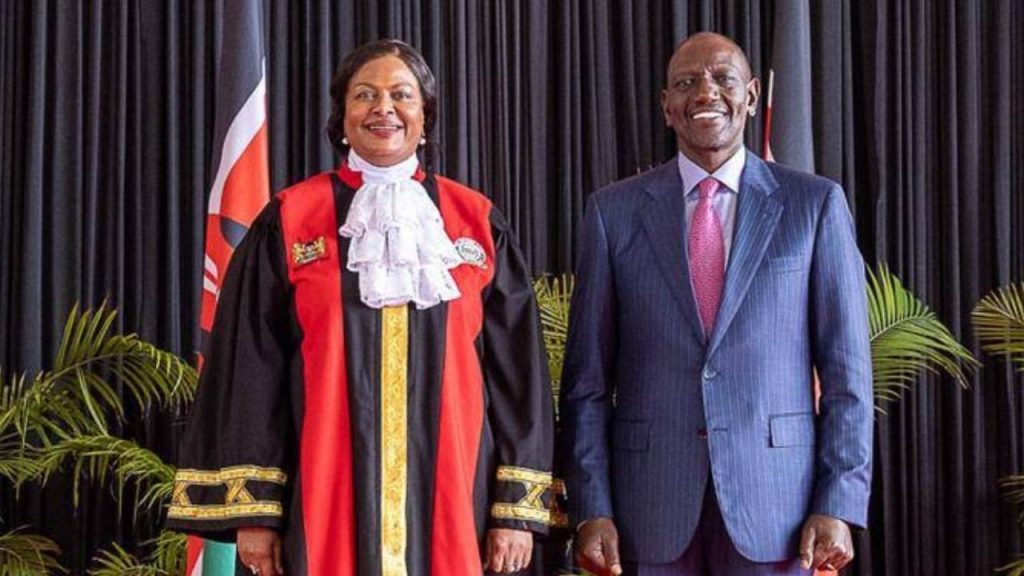
Speaking during the formal launch of Supreme Court Judge Njoki Ndung’u’s candidacy for the ICC bench, Ruto said Kenya was backing an international justice system founded on fairness, judicial independence, integrity and equal application of the law.
The president maintained that the legitimacy of international courts depends on consistency, evidence and impartiality, warning that confidence in global justice weakens whenever prosecutions appear vulnerable to geopolitics, unequal power relations or selective enforcement.
“International justice cannot endure if it is perceived as selective or preferential. No global institution can command enduring confidence if justice appears vulnerable to geopolitics or unequal power relations,”Ruto said during the ceremony at State House, Nairobi.
Kenya formally launched Ndung’u’s bid for election to the ICC for the 2027-2036 term ahead of elections scheduled for December 2026 during the 25th Assembly of States Parties in New York, where six judicial vacancies will be filled.
The launch follows weeks of diplomatic lobbying by Nairobi, including engagements with French President Emmanuel Macron, Liberian President Joseph Boakai and Ivorian President Alassane Ouattara during the Africa Forward Summit in Nairobi.
Ruto framed the candidacy as both a question of institutional legitimacy and African representation, arguing that a court drawing a majority of its cases from African countries must also include Africans shaping its jurisprudence and decisions.
“Africa cannot remain merely the subject of international justice. Africa must help shape international justice,” the president said.
Kenya remains closely associated with the ICC following investigations into the 2007-2008 post-election violence that killed more than 1,100 people and displaced hundreds of thousands.
Among Kenyans tried at the court were President Ruto, former President Uhuru Kenyatta, broadcaster Joshua arap Sang and former Head of Public Service Francis Muthaura. All the cases eventually collapsed because of insufficient evidence or witness-related challenges.
Despite Kenya’s difficult history with the court, Ruto struck a pro-ICC tone, insisting the institution remains necessary in holding perpetrators accountable regardless of political, military or economic status.
The ICC has faced criticism from several African governments and legal scholars who argue that the court has disproportionately focused on African leaders and conflicts while alleged crimes in other regions receive less scrutiny.
Ndung’u, born in 1966, brings more than three decades of experience spanning criminal prosecution, constitutional reform, legislation and judicial service.
She began her legal career as a State Counsel in the Office of the Attorney General between 1989 and 1993 before serving with the United Nations High Commissioner for Refugees and later working as a Political Analyst in Conflict Management at the African Union.
Ruto described Ndung’u as part of the generation of constitutional reformers who helped steer Kenya through democratic transition after the 2008 post-election crisis.
She later served on the Committee of Experts that drafted the 2010 Constitution, helping shape reforms centred on accountability, democratic renewal and institutional checks.
Ndung’u also served as a nominated Member of Parliament between 2003 and 2007, where she sponsored the Sexual Offences Act of 2006, legislation widely credited with strengthening protections for survivors of sexual and gender-based violence in Kenya.
She additionally played a role in the development of the African Union’s Maputo Protocol on women’s rights and testified before the United States Congress in 2008 on the impact of post-election violence on women.
In 2011, she became one of the inaugural judges of Kenya’s Supreme Court under the new constitutional order and has since participated in landmark rulings on constitutional interpretation, electoral disputes and fundamental rights, including the court’s 2017 presidential election annulment decision.
In January 2026, Ndung’u was elected unopposed as the Supreme Court’s representative to the Judicial Service Commission.
Ruto said Kenya subjected candidates to a rigorous internal selection process before settling on Ndung’u under the Rome Statute requirements.
“Kenya reviewed her record, reflected on her distinguished service on our Supreme Court, and considered her lifelong contribution to constitutionalism, gender justice and the protection of the vulnerable,” he said.
If elected, Ndung’u would become the second Kenyan to serve as an ICC judge after Justice Joyce Aluoch, who sat on the court between 2009 and 2018 and later rose to become its First Vice-President.
Kenya’s legal footprint at The Hague has continued to grow over the years. Kenyan lawyer Catherine Ngila currently serves as registrar of the ICC, while dozens of Kenyan advocates are accredited to practise before the court.
Kenya ratified the Rome Statute on March 15, 2005, formally joining the treaty that established the ICC.
“The majority of cases before the ICC have involved African situations, African communities, and African victims seeking justice,” Ruto said, arguing that stronger African representation on the bench was necessary for the court’s universality, legitimacy and credibility.
About The Author