Ruto Urges Schools To Prioritize AI, Data And Digital Skills
He said services already account for more than half of Kenya’s economy, spanning finance, transport, tourism, health, education, professional services and the digital economy.
By Our Correspondent
Kenya must reshape its education system around rapidly changing workplace skills, including artificial intelligence, data, technological literacy, creative and analytical thinking, resilience and lifelong learning, President William Ruto said.
Ruto said the pace of technological and economic change was altering the skills workers would need, making it necessary for Kenya to prepare learners for jobs that may look different from those available today.
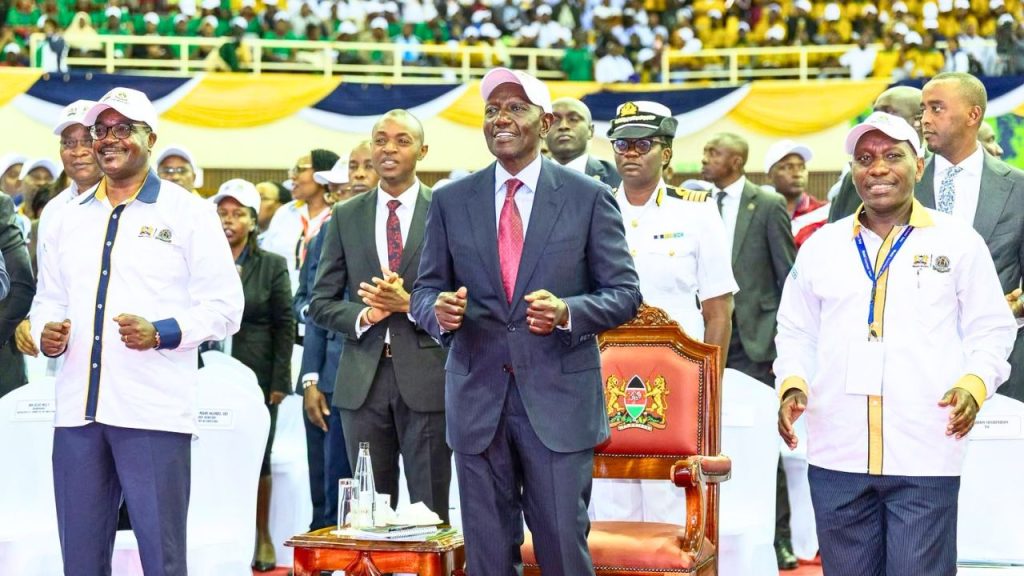
“The World Economic Forum estimates that by 2030, nearly four in every 10 skills that workers rely on today will change,” Ruto said during World Teachers’ Day celebrations at Kasarani Gymnasium in Nairobi.
He identified artificial intelligence, data, technological literacy, creative and analytical thinking, resilience and lifelong learning among the skills expected to rise in importance as economies become increasingly technology-driven.
Ruto linked the changing skills landscape to Kenya’s broader economic transformation, saying the country must strengthen its human capital if it is to create quality jobs, increase incomes and compete in global markets.
He said services already account for more than half of Kenya’s economy, spanning finance, transport, tourism, health, education, professional services and the digital economy.
“If we are to achieve double-digit growth, create millions of quality jobs and raise the incomes of our people, we must build a modern, knowledge-driven economy while continuing to strengthen agriculture, manufacturing, and production,” he said.
The President said technology was also expanding the geographical reach of Kenyan workers, allowing professionals to provide services to clients and employers outside the country.
A software developer in Kisumu, for example, can work for a client thousands of kilometers away, while a nurse trained in Nyeri can serve in a hospital abroad and an accountant in Nairobi can provide professional services to a company on another continent, he said.
Ruto said Kenya should therefore seek to export not only agricultural and manufactured products but also the skills and expertise of its workforce.
“Kenya must therefore increasingly be able to export not only what we grow and manufacture, but also what our people know and what they can do,” he said.
He described skills as the essential resource underpinning a knowledge-driven economy, arguing that Kenya must develop its own talent rather than depend on imported expertise.
“A factory can import a machine. But a nation must develop its own talent,” Ruto said.
The President tied the skills agenda directly to education, saying the foundations of Kenya’s future workforce are laid in classrooms.
He said engineers, scientists, nurses, researchers, coders and entrepreneurs all acquire the basic abilities to read, reason, question and solve problems through education.
“That is why Science, Technology, Engineering and Mathematics must occupy a central place in our education system,” he said.
Ruto called for stronger performance in mathematics and sciences and increased investment in the development of scientists, engineers, technologists, researchers and innovators.
He also said young Kenyans needed greater exposure to digital, scientific and technological capabilities demanded by the changing economy.
The government is already seeing increased interest in STEM subjects under the Competency-Based Education system, Ruto said. Mathematics emerged as the best-performing subject in the previous year’s KCSE examination, while 58 percent of the pioneer CBE class selected the STEM pathway in Senior School.
He said the government must nevertheless move faster in preparing learners for the future labor market.
“This is not simply an education agenda. It is an economic transformation agenda,” Ruto said.
He explained that the quality of education would determine the skills available to the economy, while those skills would influence the country’s capacity to produce, innovate and export.
“What we produce, innovate and export will determine how fast our economy grows,” he said.
At the center of the transformation, Ruto placed teachers, saying the changing nature of work requires changes in how learners are taught.
“Our children cannot learn tomorrow’s skills from yesterday’s methods,” he said.
He challenged teachers to continuously upgrade their own skills, particularly in digital tools, while encouraging curiosity, experimentation and analytical thinking among learners.
“I therefore challenge every teacher to be the first learner in the classroom. Master the digital tools. Model the curiosity you want to see in your learners. Reward the question as much as the answer. Make room for experiment. Build classrooms where failure is a lesson, not a verdict,” Ruto said.
The government is supporting teacher professional development through the Teachers Service Commission and institutions including the Centre for Mathematics, Science and Technology Education in Africa, the Kenya Education Management Institute and the Kenya Institute of Special Education.
Ruto said these institutions would be strengthened as part of efforts to ensure teachers can adapt to changing demands in education.
The President also said Parliament had an opportunity, through ongoing education reform proposals, to anchor teacher preparation and continuous professional development in law.
The proposed approach would require teachers to remain learners throughout their careers, with opportunities to acquire new skills, improve classroom practice, innovate and share effective approaches with other educators.
Ruto said the broader goal was to build an education system capable of supplying the human capital required by Kenya’s future economy.
The policy shift comes as the government links education more directly to economic transformation, including its ambition to create jobs, increase productivity and expand Kenya’s participation in the digital and global services economy.
The President said sustained economic growth would ultimately depend on increasing the productivity of Kenyan workers, encouraging innovation, producing higher-value goods and services and competing successfully in international markets.
“Our ambition to become a first-world nation within a generation ultimately depends on our human capital,” Ruto said.
He said Kenya could not achieve sustained high growth by relying on raw materials alone and must instead invest in the knowledge and capabilities of its people.
The policy now places schools and teachers at the center of that strategy, with the government seeking to align what learners acquire in classrooms with the skills employers and economies are expected to demand in the coming years.
About The Author