REVEALED: What Killed ‘Blood Parliament’ Filmmaker Nick Wambugu
Wambugu, a videographer and filmmaker, rose to national and international attention following the release of Blood Parliament, a BBC Africa Eye investigation that examined the killing of unarmed protesters during the anti-tax demonstrations of June 2024.
By Our Correspondent
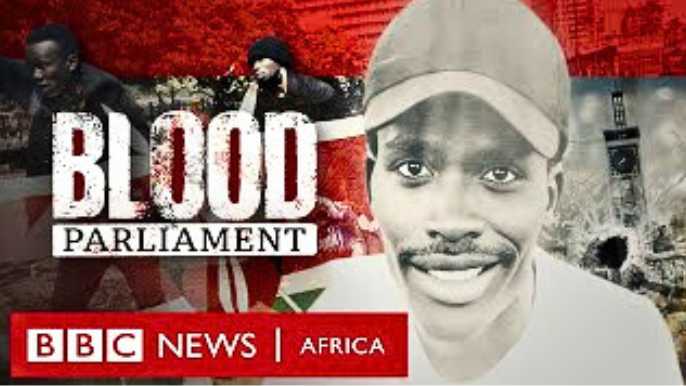
Kenyan filmmaker Nick Wambugu, who was part of the production team behind the BBC documentary Blood Parliament, has died.
His family and lawyer confirmed on Wednesday that the 34-year-old passed away after a prolonged illness linked to a rare blood disorder.
Wambugu, a videographer and filmmaker, rose to national and international attention following the release of Blood Parliament, a BBC Africa Eye investigation that examined the killing of unarmed protesters during the anti-tax demonstrations of June 25, 2024.
The documentary sparked intense public debate and political backlash. Days after its release in mid-2025, Wambugu and three others were arrested over claims they were involved in its production. He later filed a complaint accusing police of planting spyware on his phone while he was in custody, allegations that deepened concerns about media freedom in Kenya.
The government, through spokesperson Isaac Mwaura, publicly criticised the film, accusing the BBC of bias and failing to sufficiently reflect the government’s position. Despite the backlash, the documentary attracted nearly five million views globally within days of release and relied on open-source intelligence to reconstruct the fatal shootings of three young men outside Parliament.
Tributes poured in following news of Wambugu’s death. Human rights activist Hanifa Adan described his passing as heartbreaking, saying he had fought bravely and left behind a lasting legacy. Friends and colleagues remembered him as generous, principled, and deeply committed to storytelling.
His lawyer and close friend Ian Mutiso said it had been an honour to represent and know Wambugu, noting that his impact would endure beyond his years.
In the months before his death, Wambugu had openly shared his medical struggle. He was diagnosed with Hypocellular Myelodysplastic Syndrome (MDS), a rare condition in which the bone marrow fails to produce enough healthy blood cells.
MDS is a rare condition in which the bone marrow becomes depleted and cannot produce adequate healthy blood cells. This leads to anaemia, frequent infections, bleeding or bruising, severe fatigue, and other complications.
His illness, which began with persistent fatigue in late 2025, worsened steadily. Doctors were unable to identify a specific cause, saying it could be hereditary or triggered by other factors.
As his condition deteriorated, Wambugu and his family appealed publicly for help, saying he required about Sh9 million for a life-saving bone marrow transplant in India. In one of his final social media posts, he announced plans for a medical fundraiser and reflected on his career documenting resilience, noting that he had become part of the story he often told through his lens.
A bone marrow transplant is the only treatment with curative potential for Hypocellular MDS, but it is complex and costly. Wambugu did not live to receive the procedure.
He is survived by family, friends, and a body of work that placed him at the centre of one of the most consequential media investigations in recent Kenyan history.
About The Author