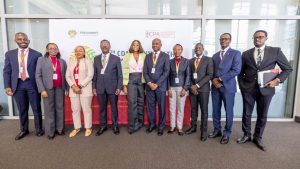
Mudavadi: Africa Must Unlock $1.1 Trillion Institutional Capital
For Kenya, he said the priority was to ensure that economic growth translated into productive investment, industrial expansion and quality jobs, especially for Africa’s fast-growing young population.
By Our Correspondent
Prime Cabinet Secretary and Cabinet Secretary for Foreign and Diaspora Affairs Musalia Mudavadi has urged African countries to cut their reliance on costly external financing by tapping the continent’s large pools of institutional capital.
Speaking on Monday while representing President William Ruto at the inaugural Africa Capital Week 2026 in Nairobi, Mudavadi said Africa’s economic sovereignty would depend on its ability to mobilise, deploy and retain capital for its own development.
He said, however, that economic sovereignty should not be confused with isolation from global markets.
“Economic sovereignty does not mean economic isolation. True sovereignty demands that Africa engages the global financial system from a position of domestic strength, structural clarity and policy stability,” Mudavadi said.
The Prime Cabinet Secretary said Africa’s financing challenge was not simply a lack of money, but structural weaknesses that stop available capital from flowing into productive investment.
He pointed to pension funds, insurance companies and sovereign wealth funds, which together control more than $1.1 trillion in assets, as a possible source of financing for infrastructure, businesses and regional value chains.
Mudavadi said African institutional investors should put more of their money into local economies to help narrow the continent’s development financing gap.
He cited estimates showing that redirecting just five per cent of the $485 billion held by leading pension and sovereign funds into local infrastructure and private equity could unlock more than $24 billion in long-term capital.
He said deeper and more efficient capital markets would also help African governments reduce their dependence on expensive commercial foreign-currency borrowing as countries face tight fiscal space and rising debt pressures.
According to Mudavadi, stronger capital markets could provide long-term financing for infrastructure projects, support business expansion, widen citizen ownership of national assets and help protect economies from foreign-exchange shocks.
For Kenya, he said the priority was to ensure that economic growth translated into productive investment, industrial expansion and quality jobs, especially for Africa’s fast-growing young population.
He said the government remained committed to an inclusive economic transformation agenda that would give Kenyans more opportunities to take part in and benefit from economic growth.
Mudavadi urged delegates at Africa Capital Week to move beyond policy declarations and deliver real investment outcomes.
“The success of this week will be measured not by the length of our communiqués, but by the transaction pipelines formed, policy commitments made and capital commitments directed into green infrastructure, mid-market enterprise and regional value chains,” he said.
He described Nairobi as a major financial, logistics and diplomatic hub on the continent, saying Kenya was ready to share its experience in capital-market reforms while also learning from other African countries.
Mudavadi said Africa had a chance to finance its own transformation and take greater control of its economic future.
“We stand on a great opportunity to build an Africa that mobilizes its own capital, funds its own infrastructure and shapes its own economic destiny,” he said.
About The Author