How Samia Elders Are Leading Grassroots Push to Restore Tree Cover
Busia County’s development plans cite charcoal burning, timber harvesting, land conversion and short-term income needs as key drivers of deforestation.
By Our Correspondent
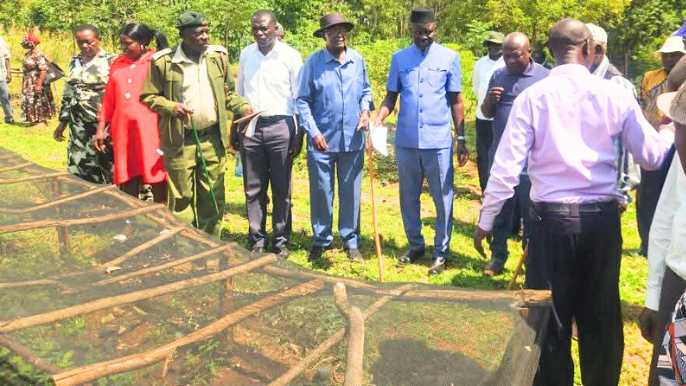
At dawn in Nanjekho Village, the soil is still cool and damp. Seedlings line the edge of a small nursery, their thin leaves catching the early light. Bent backs move slowly between rows, hands firm from decades of farm work pressing young trees into the ground.
These are members of the Samia Senior Citizens Community-Based Organization (CBO), a group of 49 men and women aged 60 and above who have turned a half-acre plot in Samia Sub-County, Busia County, into a quiet centre of environmental restoration.
The group began in November 2021 with little attention and modest ambition. They started by raising tree seedlings and supplying them to local institutions once the plants were ready for transplanting. The aim was simple: restore tree cover in a place where it had steadily disappeared and involve the community in protecting what was planted.
Three years on, the impact has stretched well beyond the nursery fence. The CBO estimates it has reached more than 2,000 people through seedling distribution and environmental outreach in schools, markets, shopping centres and health facilities across Samia.
For Steve Ogalle, the group’s chairperson and an environmentalist, the work is rooted in memory. At 86, he has watched the Samia landscape change from forested hills to bare slopes.
“We grew up when Samia hills were green,” he said. “Most of those forests have been cut down. We want our grandchildren to see that again.”
Busia County has one of the lowest forest cover ratios in Kenya. As of 2020, natural forests accounted for about one percent of the county’s land, while non-natural tree cover stood at just over half a percent. Global Forest Watch data shows small but steady losses each year.
Yet nearly 894,000 people live in Busia County, spread across roughly 169,500 hectares. Samia Sub-County alone is home to an estimated 107,176 residents. Pressure on land, fuel and livelihoods remains high.
When the seniors first began, few people noticed.
“Initially, nobody knew who we were or what we stood for. With time, the community began to feel our impact, including the county government, which we now work with on several occasions,” Mzee Ogalle said.
Environmental conservation and afforestation are recognised priorities in Busia County’s Integrated Development Plans for 2018–2022 and the current 2023–2027 cycle under Governor Paul Otuoma. The county’s climate change action plan also identifies community-led afforestation as a key response to land degradation and changing rainfall patterns.
Samia Sub-County Forest Officer Gilbert Naderia says the call to residents is constant.
“We continue to encourage tree planting, agroforestry integration and protection of riparian land,” he said.
Despite policy commitments, implementation gaps persist. Countywide programmes often lack clear planting targets, reliable seedling supply chains, well-supported nurseries and sustainable financing. The Samia seniors see their work as filling those gaps from the ground up.
For Moses Obara, the group’s treasurer, the motivation is generational.
“We want our grandchildren to experience what we saw growing up,” he said.
Experts say the difference between success and failure lies in what happens after planting. Method Okwaro, a tree expert based in Busia, stresses that survival matters more than numbers.
“Tree planting and caring for trees are two different things,” he said. “That is why we encourage people, especially schoolchildren, to adopt trees and take responsibility for them.”
Busia County’s development plans cite charcoal burning, timber harvesting, land conversion and short-term income needs as key drivers of deforestation. Mixed farming systems that combine crops and trees are proposed as a long-term solution.
The Samia seniors have already linked conservation to livelihoods. They sell seedlings at affordable prices, depending on species, and save the proceeds for future projects and farm inputs.
“Sometimes you come to the nursery and find it half empty because of demand,” said group member Tiberious Achoka.
Naderia says the CBO offers a rare example of how experience and shared history can translate into action.
“It shows how social capital and cultural memory can be turned into something that benefits the whole community,” he said.
As the sun climbs higher over Samia, the seedlings stand quietly in the soil. The seniors may not live to walk beneath full-grown canopies again, but they are planting them all the same.
About The Author