Free Eye Camp Restores Sight For 2,000 Needy Nakuru Residents
For James Muchiri and Chege Mbatiah, they couldn’t afford the essential surgeries. They said the initiative had transformed their lives immeasurably by restoring their vision at no cost.
By Suleiman Mbatiah
More than 2,000 elderly and vulnerable people in Nakuru and surrounding communities are set to benefit from free cataract screening and surgery in a groundbreaking humanitarian initiative.
The project, led by Hands for Charity in partnership with the Islamic Development Bank and the Blooms Hospital – Nakuru, conducted screenings within a 70-kilometre radius of Nakuru City.
Hands for Charity is a global humanitarian organization focused on compassion, community empowerment, partnerships, and health outreach for vulnerable populations.
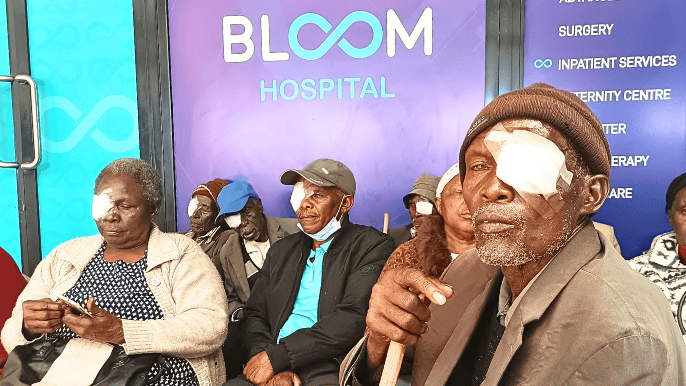
About 500 patients identified as needing urgent cataract surgery have already started receiving the life-changing procedure at Bloom Hospital – Nakuru at Golden Life Mall at no cost.
Dr Mohamed Habsah, Health Lead at Hands of Charity, said the initiative targets the most marginalized communities.
“It’s mainly directed at the most vulnerable people in the area. Those who are not covered by the national insurance programme. Those who cannot afford the cost of medical service,” he said.
He said the initiative was the first cataract treatment campaign funded by the AAA-rated bank’s community outreach programme and will expand to more medical needs in future.
The surgical team uses advanced phacoemulsification technology, deploying ultrasonic energy to break apart cloudy lenses and replace them with artificial intraocular lenses, restoring clear vision.
Dr Mansour Yildirim, a Consultant Ophthalmologist at Bloom Hospital, said cataract prevalence in the region exceeds 30 per cent.
“The main condition is the tropical area. Ultraviolet rays change the component of the lens and make it opaque,” he explained.
Most cases involve age-related cataract in people over 50 years. But the team has also treated congenital cataracts in children.
Dr Yildirim warned that untreated cataracts can lead to glaucoma, causing irreversible blindness, and patients should seek early medical attention.
However, Dr Ahmed Farrag, the project coordinator, said the team doesn’t wait for patients to come to the Golden Life Mall-based hospital.
“We go to them because we know some of these patients are not even able to come to the hospital,” he said.
The team conducts community screenings in coordination with county governments. Patients receive comprehensive pre-surgery counselling and one month of post-operative care.
Surgeons operate on the most affected eye first. The second eye is treated two to six weeks later.
He explained that patients can see clearly the day after surgery thanks to the advanced technology. Each receives a one-month supply of medication.
Ms Regina Gathoni from Umoja 2, Lanet, returned for right-eye surgery after successful treatment of her other eye months late last year, which she said had transformed her distance vision.
“I can now see distant objects very clearly. After this surgery, I will be completely fine. I am very happy,” she said, expressing deep gratitude to the sponsors and medical team.
For James Muchiri and Chege Mbatiah, they couldn’t afford the essential surgeries. They said the initiative had transformed their lives immeasurably by restoring their vision at no cost.
Nicholas Togoch of Eldama Ravine, Baringo County, sought help at multiple hospitals for his seven-year-old son unsuccessfully. He hopes the free medical camp will provide healing.
About The Author