First Lady Pushes for Policy-Driven Climate Action in Schools
By Suleiman Mbatiah
First Lady Rachel Ruto has called for the integration of environmental education and tree planting initiatives into school policies to strengthen Kenya’s response to climate change.
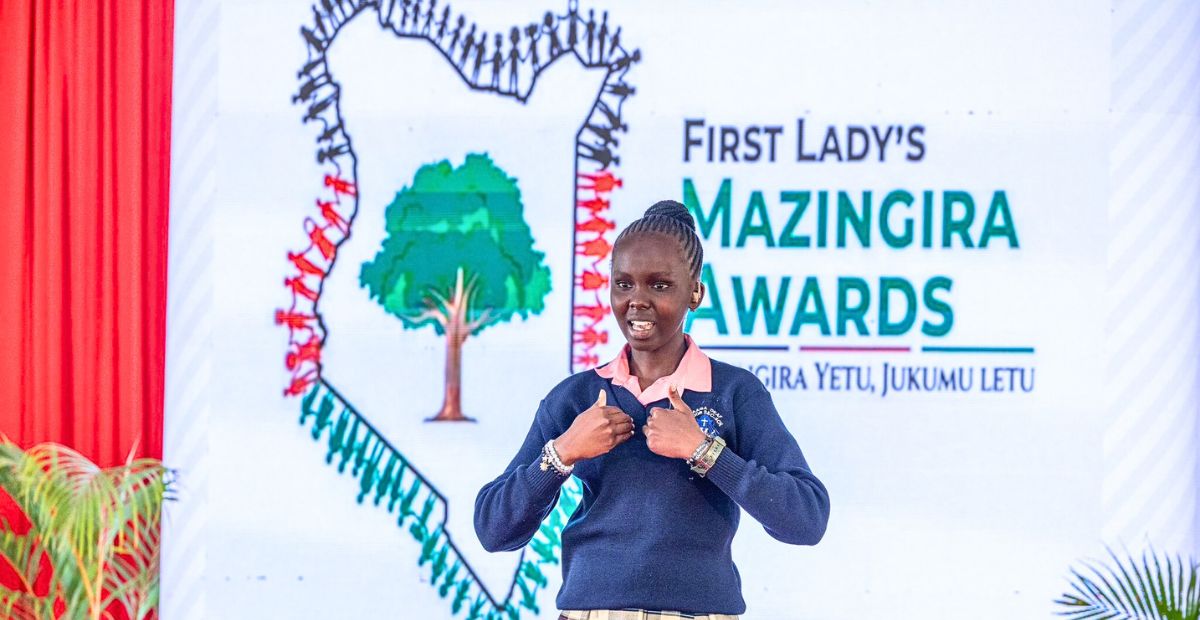
Speaking at State House Nakuru during the 2025 First Lady’s Mazingira Awards (FLAMA), Mrs. Ruto urged learners, teachers, and policymakers to view environmental stewardship not as a seasonal activity but as a structured, ongoing national effort embedded in Kenya’s education and development agenda.
“The Mazingira Awards are more than a celebration of creativity—they are a call to institutionalize environmental learning,” she said. “We are nurturing a generation that not only understands but also leads the fight against climate change.”
Launched in 2023, FLAMA aims to empower learners to creatively engage with environmental issues through art, innovation, and community action. In two years, the initiative has reached nearly one million learners in more than 2,000 schools across all 47 counties.
Mrs. Ruto said the programme complements President William Ruto’s “Jaza Miti” initiative, which targets the planting of 15 billion trees by 2032. Her office has pledged to plant and nurture 500 million trees within the same period.
“The President believes that when we equip our learners with environmental knowledge and a sense of responsibility, we secure not just their future but the future of our nation,” she said.
The First Lady underscored the importance of aligning school-based conservation programmes with national environmental policies such as the National Tree Growing Restoration Campaign and the Climate Change Act 2016, which was amended in 2023 to enhance public participation and capacity-building in climate governance.
Environment Principal Secretary Eng. Festus Ng’eno commended the First Lady for advancing youth participation in climate action through FLAMA, saying the initiative is consistent with the United Nations Framework Convention on Climate Change (UNFCCC) Action for Climate Empowerment (ACE).
“Children and youth are key agents of change. Through FLAMA, Kenya is putting policy into practice by embedding environmental awareness in the country’s education system,” said Ng’eno. He urged schools to establish fruit orchards and kitchen gardens as part of a long-term plan to build food security and climate resilience.
Nakuru Governor Susan Kihika echoed the call for institutional reforms that prioritize conservation within counties. She noted that Nakuru has adopted practical policies that include planting one million trees annually, restoring riparian zones such as the Mireroni and Ndarugu rivers, and rehabilitating over 300 acres of degraded land.
She also praised the First Lady’s MaMa Kitchen Gardens and MaMa Fruit Gardens initiatives for linking environmental sustainability with nutrition and livelihoods.
“The combination of national programmes like Jaza Miti and community-based efforts such as MaMa Gardens is setting the foundation for policy continuity and grassroots engagement,” Governor Kihika said.
With growing participation from learners, teachers, and county governments, the FLAMA Awards have evolved into a policy-aligned environmental education model that demonstrates how national goals can be achieved through localized action.
The long-term goal, the First Lady noted, is not only to plant trees but to plant responsibility — embedding environmental consciousness in Kenya’s education system and governance frameworks to secure a sustainable future for generations to come.
About The Author