Egerton @ 86: New Book Captures University’s Leadership, Reforms and Expansion
The 600-page publication, titled Thus Until: A History of Egerton University (1939–2019), was authored by Professor Emillia Ilieva and Professor Reuben Matheka. It documents the institution’s milestones, leadership transitions, governance reforms and academic growth over eight decades.
By Suleiman Mbatiah
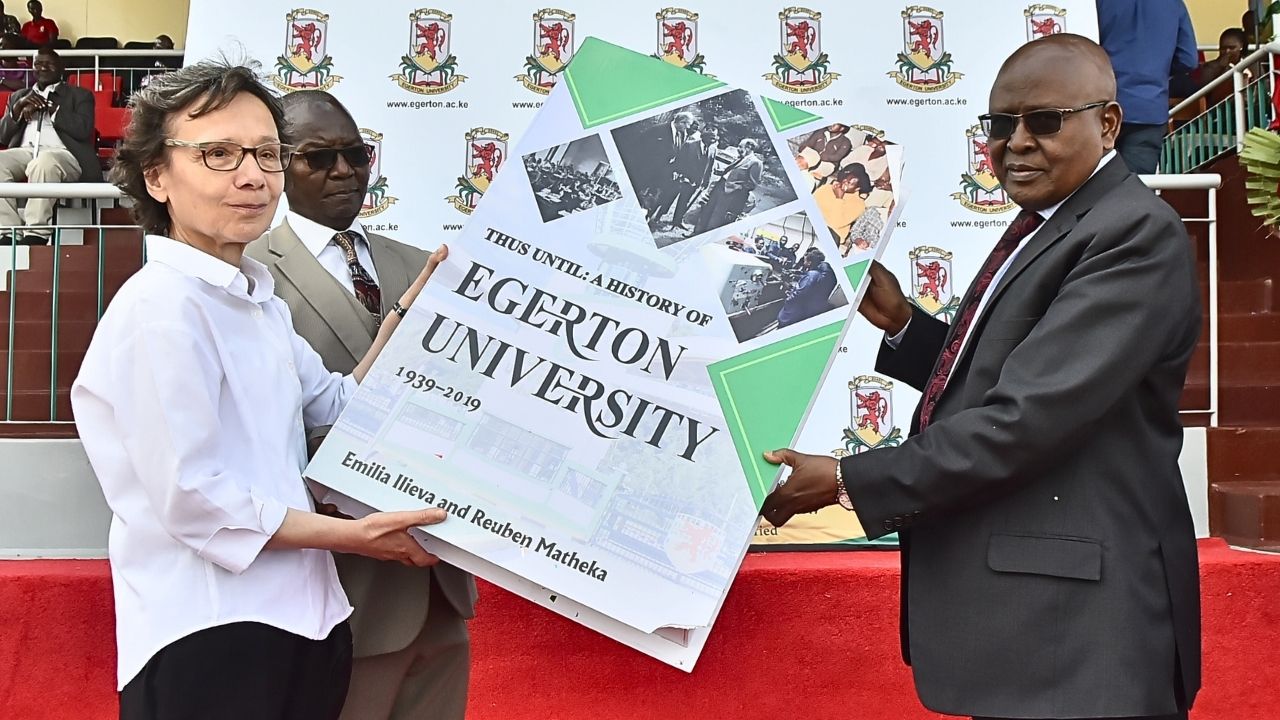
Egerton University has launched a new book chronicling its evolution from a colonial-era agricultural training institution to a modern public university, marking 86 years of existence during an Open Day ceremony held at its main campus in Njoro, Nakuru County.
The 600-page publication, titled Thus Until: A History of Egerton University (1939–2019), was authored by Professor Emillia Ilieva and Professor Reuben Matheka. It documents the institution’s milestones, leadership transitions, governance reforms and academic growth over eight decades.
The launch coincided with the university’s Open Day, commemorating its establishment in 1939 as a school for training colonial farmers in crop and livestock management before its gradual transition into a fully fledged university.
Vice Chancellor Professor Isaac Kibwage said the book offers a rigorous and candid account of the university’s journey, situating its development within the broader history of higher education in Kenya.
“The book presents a thorough, well-researched chronicle of our journey from colonial-era agricultural training through post-independence and contemporary eras,” Professor Kibwage said during the ceremony attended by government officials, staff, students and alumni.
He said although Egerton is historically associated with agriculture, it has evolved into a comprehensive institution offering programmes in engineering, medicine, education, arts, environmental studies, gender studies and law.
Professor Kibwage traced its institutional milestones, noting that Egerton became a constituent college of the University of Nairobi in 1986 before attaining full university status through a charter in 1987.
He disclosed that discussions to formally document the university’s history began in 2014 but gained momentum in 2019 when the authors agreed on a defined timeline ending that year to avoid an open-ended narrative.
“The university will continue to grow, so future editions may update or correct the current volume,” he said, adding that preserving institutional memory was essential for guiding future governance and academic decisions.
Education Cabinet Secretary Julius Ogamba, in a speech read by Dr Wahome Rureri from the State Department for Higher Education, described universities as strategic national assets whose histories should inform policy and leadership choices.
Mr Ogamba said the publication was more than a commemorative gesture, noting that decisions taken today would shape universities for decades and should be grounded in documented institutional experience.
He said the Ministry of Education was implementing reforms to strengthen governance, improve quality assurance, enhance research productivity and restore financial sustainability in public universities.
On his part, Dr Rureri welcomed Egerton’s Open Day initiative, saying it fostered engagement between the university and the public by showcasing academic programmes, research outputs and innovation initiatives.
He urged other institutions to document their histories to help future generations understand their origins, challenges and achievements within the evolving national education landscape.
Council chair Professor James Sang said the book examines governance structures, leadership transitions and policy shifts that influenced Egerton’s trajectory over the years.
“It does not romanticise the past but presents the university as it is, including moments of strain and reform,” Prof Sang said, adding that strong oversight and prudent financial management remain central to institutional stability.
Lead author Professor Ilieva said the research process involved extensive archival work, oral interviews and consultations at the Kenya National Archives to reconstruct early records, particularly from the colonial period beginning in 1939.
She said earlier attempts to write the history had stalled due to limited documentation but renewed institutional commitment enabled the team to verify sources and situate Egerton’s story within Kenya’s broader education history.
The Professor of Literature described the assignment as both an honour and a scholarly test, noting that writing an objective institutional history required corroborated evidence and contextual analysis beyond internal records.
The book is available in print and electronic formats, including online platforms, and forms part of wider efforts by the university to reflect on its past while shaping its future direction in teaching, research and community service.
About The Author