KMPDU Hails Nurses’ Return As Doctors Get Relief From Workload
KMPDU Secretary-General Dr Davji Bhimji Atellah said the prolonged absence of nurses had placed an unsustainable burden on doctors and other healthcare workers, who had been forced to take on duties outside their normal roles.
By Suleiman Mbatiah
Doctors and other healthcare workers are set to get some relief from heavy workloads in public hospitals after nurses called off their 41-day nationwide strike, removing the immediate threat of a doctors’ walkout.
The Kenya National Union of Nurses and Midwives (KNUNM) on Wednesday declared the strike, which began on July 29, over after reaching a return-to-work agreement with the Council of Governors (CoG). Nurses were directed to resume duty immediately or within 24 hours.
The breakthrough came a day after the Kenya Medical Practitioners, Pharmacists and Dentists Union (KMPDU) issued a seven-day ultimatum to the government, warning that doctors could issue a strike notice if the nurses’ grievances were not resolved.
KMPDU Secretary-General Dr Davji Bhimji Atellah said the prolonged absence of nurses had placed an unsustainable burden on doctors and other healthcare workers, who had been forced to take on duties outside their normal roles.
The doctors’ union had warned that the situation was straining teamwork in public hospitals and could compromise patient care. KMPDU said a functioning health system requires doctors, nurses and other cadres to work together, rather than one profession trying to fill in for another.
Dr Atellah welcomed the agreement between the nurses and governors, calling it an important step for the health system and for millions of Kenyans who rely on public hospitals.
“The return of nurses to our hospitals will help ease the immense pressure that has been placed on doctors and other healthcare workers over the past 40 plus days,” he said.
He said KMPDU had stood with nurses because healthcare workers could not build a functioning health system while some cadres were left behind.
He said the nurses’ return should not only restore services disrupted during the strike, but also create a chance to deal with deeper problems affecting the health workforce.
“We must now ensure that this moment becomes an opportunity to strengthen, rather than merely restore, our health system,” Dr Atellah said.
The KMPDU intervention had raised the stakes in the nurses’ dispute. On Tuesday, Atellah warned that doctors were already overburdened and could not continue performing nursing duties, giving the government seven days to resolve the matter before the union moved toward issuing a strike notice.
That threat has now been overtaken by the return-to-work agreement, with nurses expected to resume services across public health facilities.
The deal gives the parties 45 days to conclude negotiations on implementation of the 2017 collective bargaining agreement, which has remained largely unimplemented amid government concerns over funding.
It also provides for the development of a model career guideline for nursing personnel within 45 days and the employment of Universal Health Coverage staff on permanent and pensionable terms at rates approved by the Salaries and Remuneration Commission.
Among the immediate measures announced by the Council of Governors is an additional Sh8,000 in risk allowance and Sh5,000 in uniform allowance, bringing the increase to Sh13,000.
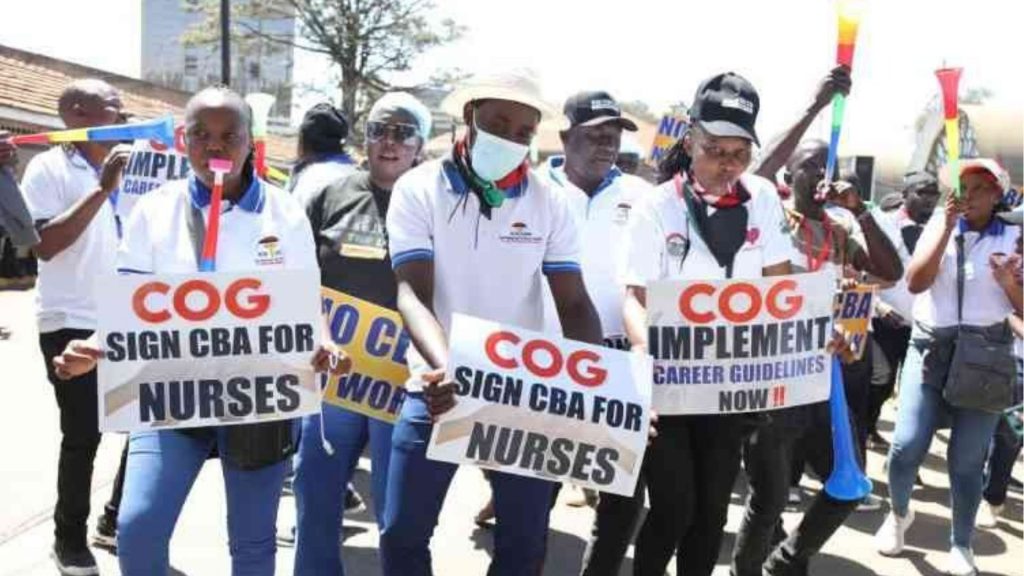
The deal follows weeks of pressure from nurses, including demonstrations and a protest at the Council of Governors’ offices, as the union pushed for implementation of previously agreed terms.
The 2017 CBA has remained at the center of the dispute, with nurses saying commitments on pay and working conditions had been delayed for years. The government has cited budget constraints.
While welcoming the return of nurses, Dr Atellah said the signing of the agreement should not be the end of efforts to improve working conditions for healthcare workers.
“We urge all parties to honor the commitments reached and to address the underlying challenges facing healthcare workers so that we do not find ourselves here again,” he said.
The union’s position reflects concern that unresolved labour disputes could continue to disrupt healthcare services if agreements are signed but not implemented.
KMPDU has previously pointed to staffing shortages, delayed implementation of collective bargaining agreements, outstanding payments and poor working conditions as some of the wider challenges facing Kenya’s health workforce.
The latest nurses’ dispute also showed how quickly problems affecting one cadre can spread across the health system. With nurses absent from hospitals, doctors and other health professionals came under greater pressure to maintain services.
For patients, the resumption of nursing services is expected to ease disruptions and allow hospitals to begin clearing backlogs built up during the more than six-week strike.
For doctors, it removes the immediate prospect of another nationwide industrial action that could have worsened disruption in public hospitals.
Dr Atellah said healthcare workers should now return their focus to patient care.
“Now, let us get back to what brought us into healthcare in the first place, serving and saving lives,” he said.
The challenge now will be making sure the latest agreement holds beyond the immediate return of nurses to their stations.
The 45-day implementation window will be an early test of whether the government and county administrations can resolve the outstanding issues that have repeatedly triggered industrial action among health workers.
For doctors, the nurses’ return is not simply the restoration of manpower in public hospitals. It is also a reminder that Kenya’s healthcare system depends on a properly staffed and fairly treated workforce.
“The work does not end with calling off the strike,” Dr Atellah said.
About The Author