Naivasha to Host National Dialogue on GMO Safety and Biotechnology Progress
Another key topic is the integration of biotechnology advances and emerging tools such as artificial intelligence (AI). Participants will explore genome editing, synthetic biology, and how AI is being used to improve crop breeding, supply chains, biosafety monitoring, and data-driven decision-making.
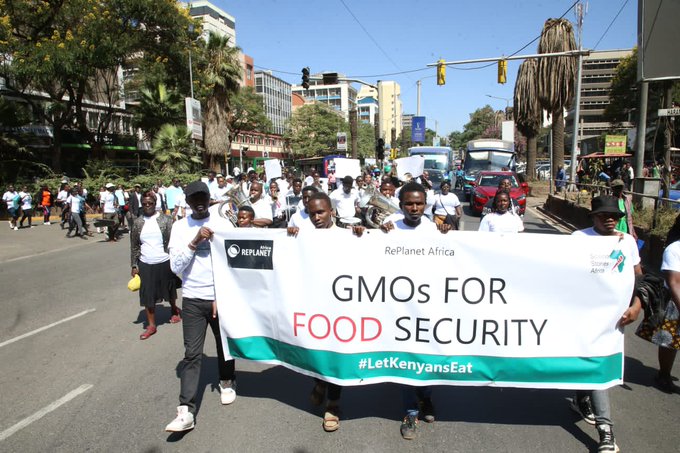
Kenyan pro-GMO activists call for the adoption of improved seed varieties. Photo/ Richard Wetaya
Experts, government officials, researchers, scholars, policymakers, farmers, and youth representatives will gather in Naivasha, Nakuru County, next week to review Kenya’s progress in adopting modern biotechnology.
The three-day conference, running from June 10 to 12, 2025, is themed “13 Years Later: Building Trust and Ensuring Safety of Genetically Modified Organisms.” It will examine the country’s journey in embracing GMOs, assess regulatory milestones, and explore future directions.
Organized by the National Biosafety Authority (NBA), this will be the 13th edition of the conference. The Authority is mandated to oversee the transfer, handling, and use of genetically modified organisms to safeguard human and animal health and protect the environment.
Agriculture and Livestock Development Cabinet Secretary, Sen. Hon. Mutahi Kagwe, is expected to officially open the conference on Tuesday, June 10.
According to NBA Acting Chief Executive Officer Nehemiah Ngetich, the event will also serve as a national dialogue on biosafety and biotechnology policy issues.
“Kenya has a well-established legal, regulatory, and institutional framework which provides for streamlined processes for persons dealing in GMOs and their derived products in the country,” Mr. Ngetich said.
He added that the framework includes clear application procedures, safety assessments, and monitoring mechanisms aligned with Kenya’s commitment to food safety, environmental protection, and the socioeconomic wellbeing of its citizens.
The conference will cover a range of sub-themes, starting with regulatory frameworks for GMO safety. Discussions will delve into the policies, laws, and institutions that govern the safe development and use of GMOs in Kenya.
It will examine both international instruments—such as the Convention on Biological Diversity and the Cartagena Protocol on Biosafety—and national oversight systems that manage compliance, risk mitigation, and public engagement.
A session on GMO safety assessment and product labeling will highlight scientific methods used to evaluate GMOs before approval for cultivation or consumption. Topics will include substantial equivalence, allergenicity, toxicity, environmental impact, and long-term health effects.
“It will cover key aspects of risk assessment, including substantial equivalence, environmental impact, allergenicity, toxicity, and long-term health effects. The discussion will highlight internationally recognized protocols and national regulatory approaches to ensure GMOs meet safety standards. The session will also elaborate the socioeconomic parameters considered for GMOs for environmental release and placing on the market,” reads the statement.
Participants will also explore labeling regulations, looking at how they promote consumer choice, traceability, and trust in GM products. The debate will also tackle the balance between voluntary and mandatory labeling, and the challenge of misinformation.
The event will feature discussions on collaborative approaches in GMO research and development, emphasizing the importance of public-private and public-public partnerships in driving innovation, ensuring safety, and sharing data and expertise.
NGOs and county governments will also be spotlighted for their roles in biosafety advocacy, policy execution, and public awareness efforts.
Another key topic is the integration of biotechnology advances and emerging tools such as artificial intelligence (AI). Participants will explore genome editing, synthetic biology, and how AI is being used to improve crop breeding, supply chains, biosafety monitoring, and data-driven decision-making.
Kenya has made notable progress in establishing a comprehensive biosafety legal framework. The journey began with the approval of the National Biotechnology Development Policy in 2006, which laid the foundation for responsible research and application of modern biotechnology. This was followed by the enactment of the Biosafety Act in 2009, a landmark law that formalized the country’s commitment to regulating genetically modified organisms (GMOs).
To operationalize the Act, four key regulations were introduced: the Biosafety (Contained Use) Regulations, 2011, which govern research involving GMOs in controlled environments; the Biosafety (Environmental Release) Regulations, 2011, which guide the release of GMOs into the environment; the Biosafety (Import, Export, and Transit) Regulations, 2011, which manage cross-border movement of GMOs; and the Biosafety (Labelling) Regulations, 2012, which ensure transparency and consumer awareness through proper labeling of GM products. Together, these laws form a robust system for overseeing biotechnology development and ensuring public and environmental safety.
The National Biosafety Authority (NBA), which serves as Kenya’s National Focal Point for the Cartagena Protocol on Biosafety, plays a key role in overseeing the country’s biotechnology governance. The upcoming Naivasha conference is expected to strengthen Kenya’s standing as a regional leader in this field, while fostering public confidence in science-based approaches to food security and environmental sustainability.
About The Author