New Book Seeks To Correct Myths About Egerton’s Origins
The authors expressed hope that the publication will strengthen Egerton’s historical awareness, inspire further research and guide present and future generations in understanding the institution’s complex and transformative journey.
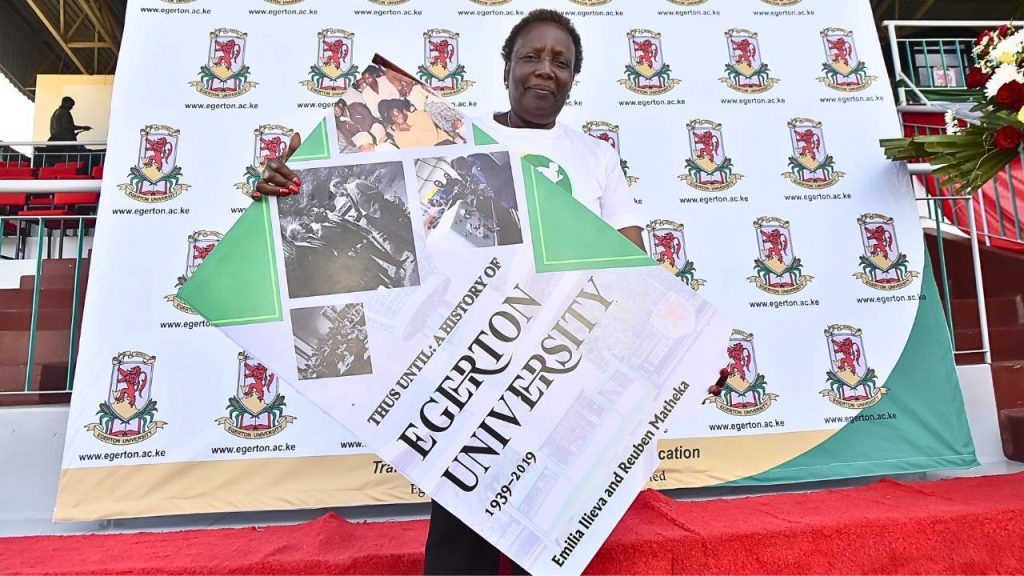
By Suleiman Mbatiah
A new book of Egerton University seeks to correct half-truths about the institution’s origins and challenge widely held myths that have shaped its public image for decades.
Speaking during the launch of Thus Until: A History of Egerton University, 1939–2019 at Egerton University on Friday last week, co-author Professor Emilia Ilieva said the project aimed to produce an unembellished record grounded in verified facts.
The book accounts Egerton’s transformation from an exclusive colonial agricultural school for white settlers into a national public university, reshaped by independence and opened to serve a broader Kenyan society.
“It would be a travesty of the idea that the university as an institution is a citadel of knowledge, if, out of wilful ignorance, we continued to repeat and believe in half-truths and false stories,” Professor Ilieva said.
The book disputes popular claims about the university’s early years, including the oft-repeated story of three founding students and assertions that Lord Egerton barred women from the institution.
Professor Ilieva said the decade-long research showed that history is defined not by anniversaries but by the weight and consequence of human actions over time.
“It is not the mere passage of time that makes history and is, therefore, worthy of celebration,” she said, noting that the transition required intellectual and structural rebuilding unmatched by other universities on the continent.
She added that without a firm grasp of the past, institutions risk losing direction and diminishing their future possibilities, saying “We are rootless without history”.
The Professor of Literature said Egerton is unique in Africa because it began as an exclusive institution and later transformed into a national university serving all Kenyans.
The authors drew on archives in Kenya and abroad, including Tatton Park, the British Library, Cambridge University Library, the Bodleian Library, and the United Nations Library at Geneva.
Professor Ilieva said Egerton’s history has drawn global academic interest, with established journals requesting review copies and overseas universities acquiring the book.
Professor Reuben Matheka described the publication as a key reference for Egerton’s institutional memory, saying it offers a foundation for future scholarship and deeper research into the university’s evolving history.
“Among other things, the book we are launching today is an important reference point for Egerton’s institutional memory,” Matheka said, adding that the work situates Egerton within Kenyan, African and global developments since 1939, particularly in agricultural education and training.
The professor of History said the institutional memory that the book tries to summarise from a big mass of information and that the publication should serve as a foundation for further research by postgraduate students, alumni and staff.
He cited autobiographies by James Butt, William Omamo and Prof Njenga Munene as examples of how personal recollections enrich Egerton’s institutional memory and deepen understanding of its academic and administrative evolution.
Both authors acknowledged encouragement from colleagues and supporters of the book project, including Prof Alfred Kibor and Mzee Zablon Ong’ori, who mobilised interviewees and consistently pressed for the publication’s completion.
They said the research was strengthened by strong institutional backing, collaboration with colleagues and extensive interviews, which enabled them to assemble a detailed and credible account of Egerton’s historical development.
The authors expressed hope that the publication will strengthen Egerton’s historical awareness, inspire further research and guide present and future generations in understanding the institution’s complex and transformative journey.
About The Author