Contributors Died, But Egerton’s 86-Year History Finally Sees The Light
Research for the book drew on extensive international archives, including records from the United Kingdom, Europe and the United States.
By Suleiman Mbatiah
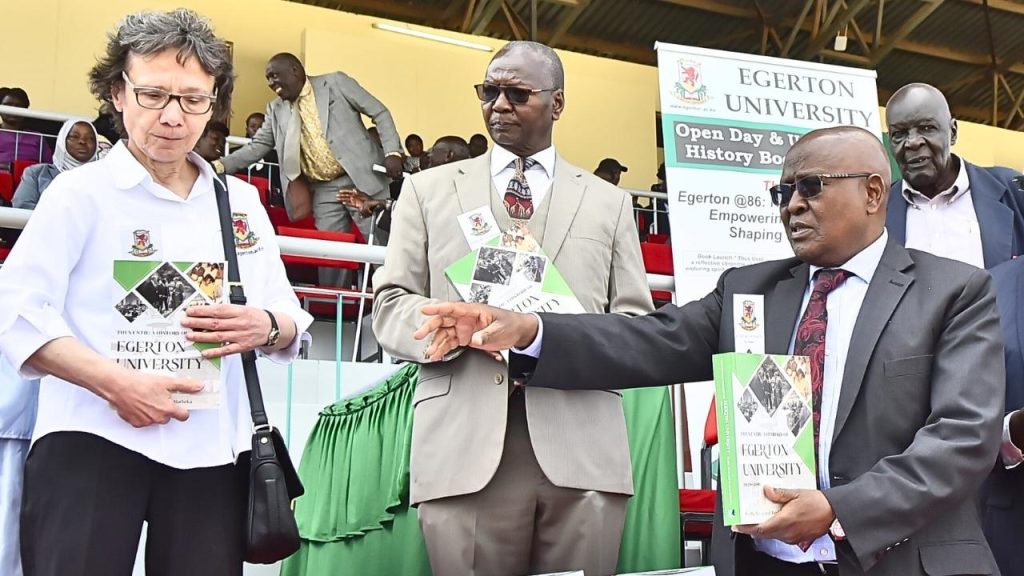
Some contributors have since died, but that did not stop the publication of Thus Until: A History of Egerton University, 1939–2019, launched Friday at Egerton University.
The book, completed after a decade of research, was unveiled during celebrations marking 86 years since the institution’s founding in 1939.
Co-author Professor Emilia Ilieva said the long journey to publication outlived several of the 57 interviewees who helped reconstruct the university’s past.
“Sadly, a number of the 57 individuals who gave us interviews are not with us to share this moment,” Ilieva said.
She described the work as an unembellished account built on archival evidence and oral testimony collected across generations of staff and alumni.
“It is not the mere passage of time that makes history and is, therefore, worthy of celebration,” she said.
Ilieva said the book sought to correct half-truths about the institution’s origins and challenge widely held myths.
“We are rootless without history,” she said.
The authors argue that Egerton occupies a unique place in Africa’s higher education landscape, having begun as a settler agricultural school that excluded Africans before transforming after independence.
Unlike most African universities, which emerged as colonial colleges or post-independence national institutions, Egerton had to remake itself entirely in a new political era.
Ilieva said that transformation required deliberate rebuilding and remains central to understanding the university’s identity.
Research for the book drew on extensive international archives, including records from the United Kingdom, Europe and the United States.
Institutions such as Tatton Park and the British Library provided access to rare documents, including the digitised diaries of Maurice Egerton.
Back home, Egerton’s library and archivists opened previously unexplored records, while the university management granted unrestricted access without censorship, the authors said.
Vice-Chancellor Isaac Kibwage supported the project, alongside other former administrators and scholars who encouraged its completion.
The book has already attracted attention from reviewers and academic journals and has been stocked in overseas university libraries, including the University of California, Berkeley.
Speaking at the launch, co-author Professor Reuben Matheka described the publication as a consolidation of Egerton’s institutional memory.
“History is magistra vitae — a teacher of life,” Matheka said.
He said the volume places Egerton at the centre of Kenyan, African and global developments, particularly in agricultural education and training.
“The book is therefore useful not just to the current and future generations of Egertonians, but also the broader society,” he said.
Matheka added that the work should serve as a foundation for further research into campuses, faculties and biographies of past leaders.
He tered it as a foundation upon which research on specific strands of the Egerton story can be built.
He cited autobiographical works by former Egerton figures as examples of how personal narratives deepen institutional memory.
Among them are My Life and Times by James Butt, Path to Kaliech by William Omamo and Rooted in Hope by Njenga Munene.
The book was published by East African Educational Publishers and has received positive early reviews.
For the authors, Friday’s launch marked the end of a long project sustained by colleagues, archivists and supporters who believed the story had to be told.
About The Author