Nakuru Unveils First Agroecology Policy to Transform Food Systems
Wanjama added that with the policy now in place, Nakuru aims to position itself as a national leader in climate-smart and inclusive agriculture, securing healthier diets, stronger rural economies, and a more resilient environment for future generations.
By Suleiman Mbatiah
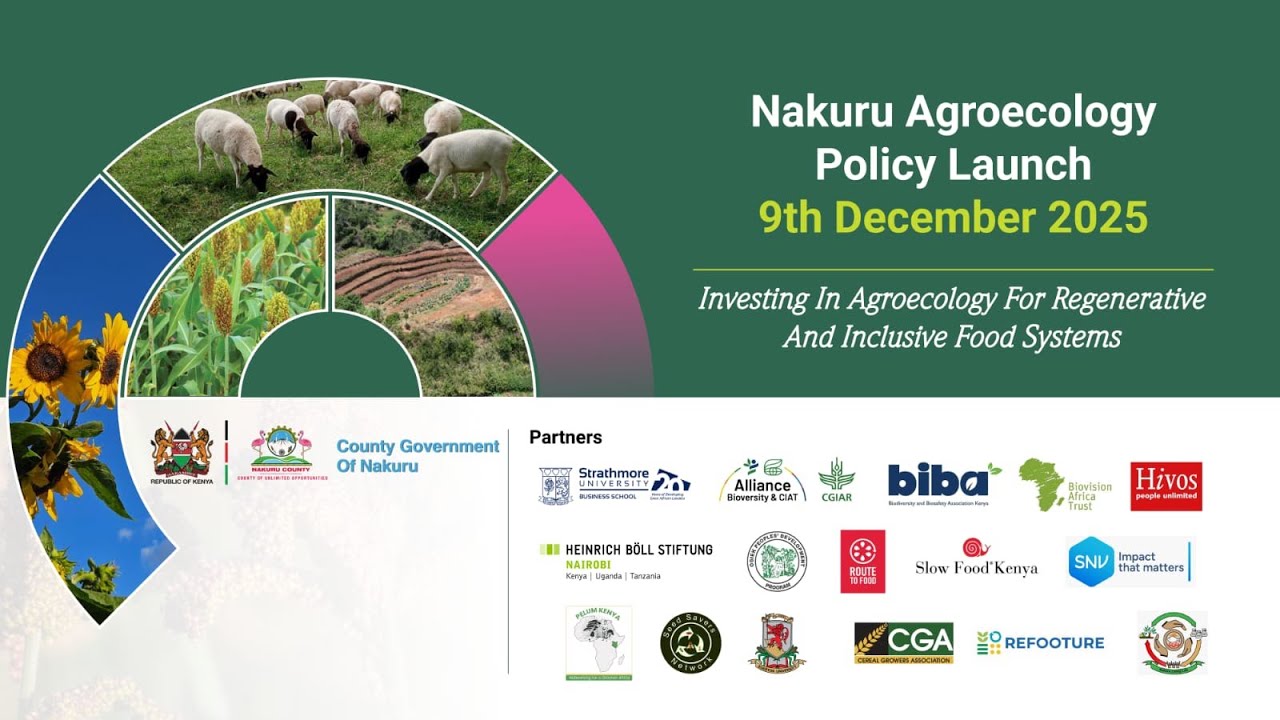
Nakuru County has launched a comprehensive agroecology policy aimed at shifting farmers toward sustainable food production, restoring degraded ecosystems, and improving household nutrition across all 11 sub-counties.
Agroecology applies ecological principles to farming by working with nature rather than relying heavily on synthetic chemicals, monocultures, and costly external inputs. It focuses on regenerating soils, conserving water, enhancing biodiversity, and building resilience to climate change.
The Nakuru County Agroecology Policy 2025, the first of its kind in the region, sets out a framework to guide farmers, researchers, cooperatives, and government agencies toward more resilient, inclusive, and environmentally sound food systems.
The policy aligns with existing county plans, including the County Integrated Development Plan, the Urban Food Agriculture Act, the Climate Change Framework, the Spatial Plan, and the Waste Management Policy.
The policy was prepared after months of consultations involving farmers, civil society groups, research institutions, and representatives of women, youth, indigenous communities, and persons with disabilities. The Seed Savers Network – Kenya played a key role in initiating the process by engaging local MCA Rose Njoroge and Assembly Agriculture Committee chairperson Isabella Makori on the need to integrate ecological principles into agricultural and food systems.
According to Daniel Wanjama, founder and director of the Seed Savers Network – Kenya, the policy responds to long-standing challenges in Nakuru’s agriculture sector, including soil degradation, declining agrobiodiversity, rising input costs, climate shocks, and growing food and nutrition insecurity.
He decried that more than 90 percent of vegetables in the markets were not fit for human consumption, urging authorities to enforce market surveillance in vegetable markets just as they do in the meat sector.
“This is a movement of hope. We are very optimistic that if the policy is fully implemented, it will improve food security in the country and overly the country’s economy and health,” he stated during the launch in Nakuru City.
Wanjama added that with the policy now in place, Nakuru aims to position itself as a national leader in climate-smart and inclusive agriculture, securing healthier diets, stronger rural economies, and a more resilient environment for future generations.

The document highlights how monocropping, excessive use of chemical fertilizers and pesticides, and aggressive tillage have weakened soils and reduced productivity. More than 50 local crop varieties have disappeared in recent years, while forests, rivers, and lakes face increasing pressure from land-use change and pollution. At the same time, extension services are overstretched, with one officer serving an estimated 1,500 farmers.
Governor Susan Kihika, in a speech read by her Deputy David Kones, emphasized that agroecology will help the county rebuild ecological systems, strengthen smallholder livelihoods, and expand opportunities for women, youth, and marginalized groups. She noted that the policy places a strong focus on farmer-managed seed systems, value addition, climate adaptation, and equitable participation in decision-making.
“As we stand here today, we recognize that policy development is one of the most powerful tools available to both national and county governments in shaping the future. Well-crafted policies create enabling environments where our farmers can thrive, our ecosystems are protected, and our people prosper,” she stated.
The policy outlines six priority areas to drive a countywide shift toward sustainable food systems. These include improving research and training through stronger partnerships with institutions such as Egerton University and KALRO, and promoting adoption of agroecological practices such as crop diversification, soil regeneration, and integrated pest management. It also emphasizes restoring biodiversity and protecting ecosystems.
Additional focus areas include strengthening agroecological markets and enterprises, embedding agroecology in legislation and planning, and ensuring that vulnerable and marginalized groups are fully included in the transition. The policy positions agroecology as both an environmental and social agenda aimed at supporting farmers while improving nutrition and building resilience.
Jane Karanja, a sustainable development expert at Network for Ecofarming in Africa (NECOFA), welcomed the policy, praising it as a platform that will drive long-term growth in the region.
“The policy will shape a clear path forward, ensuring that agroecology is at the heart of agricultural policies and practices in the region and farmers will have a platform for their own voices and seed sovereignty,” she stated.
County Executive Committee Member for Agriculture Leonard Bor said the policy will help coordinate the many actors working in the sector, reduce duplication, and align public and private investments toward a shared goal of sustainable food systems.
“The County will now prioritize resource mobilization, expand farmer training, and roll out ward-level implementation structures, alongside establishing a monitoring and information-sharing framework to track progress and support continuous learning among stakeholders,” Bor assured.
Smallholder farmers, led by Penina Ngahu from Kikopey in Gilgil sub-county, welcomed the launch, saying the policy provides legal structures that will guide their work and attract more support.
Other stakeholders, including PELUM Kenya, Hivos, Biovision Africa Trust, and the Ogiek community, expressed their commitment to protecting indigenous seeds, expanding community seed banks, and promoting underutilized traditional crops such as millet, sorghum, and indigenous vegetables.
About The Author